





by Tara Gray
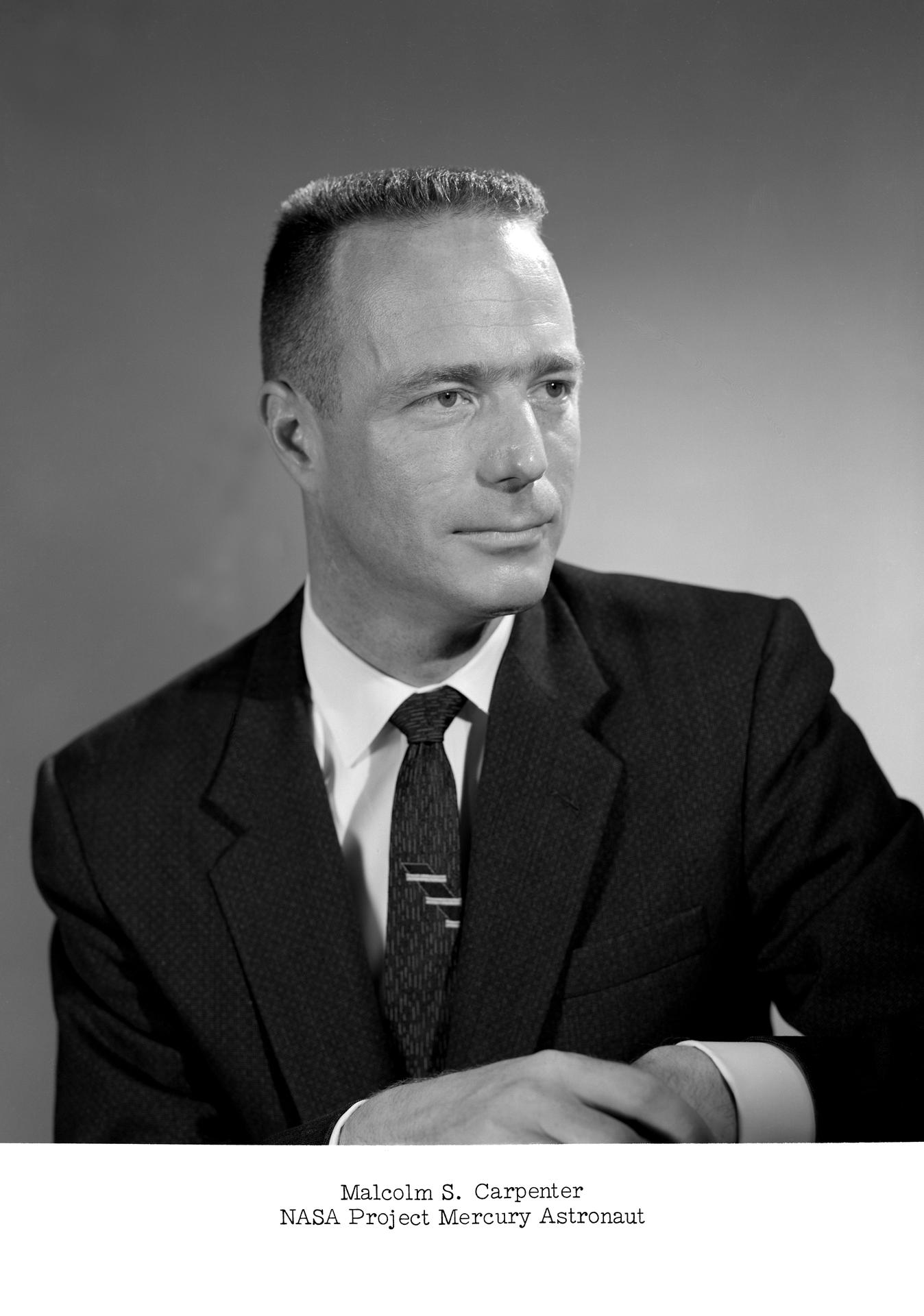
Malcolm Scott Carpenter, Commander (USN, Ret.), was born on May 1, 1925, in Boulder, Colorado, to parents Dr. Marion Carpenter and Florence Kelso (Noxon) Carpenter. His parents separated when he was 3 years old and when his mother was hospitalized with tuberculosis, he was raised by a family friend. He attended primary and secondary school in Boulder, graduating from high school in 1943. After graduating from high school, Carpenter entered the Navy’s V-5 flight training program at the University of Colorado. The program was designed to give potential pilots advanced academic training at the same time they received basic experience in aircraft.1 After a year there, he spent six months in training at St. Mary’s Pre-flight School, Moraga, California, and four months in primary flight training at Ottumwa, Iowa. When the V-5 program ended at the close of World war II, Carpenter entered the University of Colorado to major in aeronautical engineering. He received a degree there in 1949.2
Following his graduation, Carpenter joined the Navy and received flight training from November 1949 to April 1951 at Pensacola, Florida and Corpus Christi, Texas. He spent three months in the Fleet Airborne Electronics Training School, San Diego, California, and was in a Lockheed P2V transitional training unit at Whidbey Island, Washington, until October 1951.3
In November 1951, he was assigned to Patrol Squadron 6 based at Barbers Point, Hawaii. During the Korean conflict, he was with Patrol Squadron 6 engaged in anti-submarine patrol, shipping surveillance and aerial mining activities in the Yellow Sea, South China Sea and the Formosa Straits.4 In 1954 he entered the Navy Test Pilot School at the Naval Air Test Center, Patuxent River, Maryland. After completion of his training, he was assigned to the Electronics Test Division of the NATC. In this assignment Carpenter conducted flight test projects with the A3D, F11F and F9F and assisted in other flight test programs.5 He flew tests in a variety of Naval aircraft including multi- and single-engine jet aircraft and propeller-driven fighters, attack planes, patrol bombers and seaplanes.6 He then attended Naval General Line School at Monterey, California, for ten months in 1957 and the Naval Air Intelligence School, Washington, DC for an additional eight months in 1957 and 1958. In August 1958 he was assigned to the USS Hornet, anti-submarine aircraft carrier, as Air Intelligence Officer, where he was serving when he received cryptic orders to report to Washington in connection with an unspecified special project.7 Stopping in an airport on the way back from Washington, he picked up a Time magazine and learned that the newly created National Aeronautics and Space Administration (NASA) had identified 110 candidates, all military pilots, from which to take volunteers for America’s first manned venture into space.
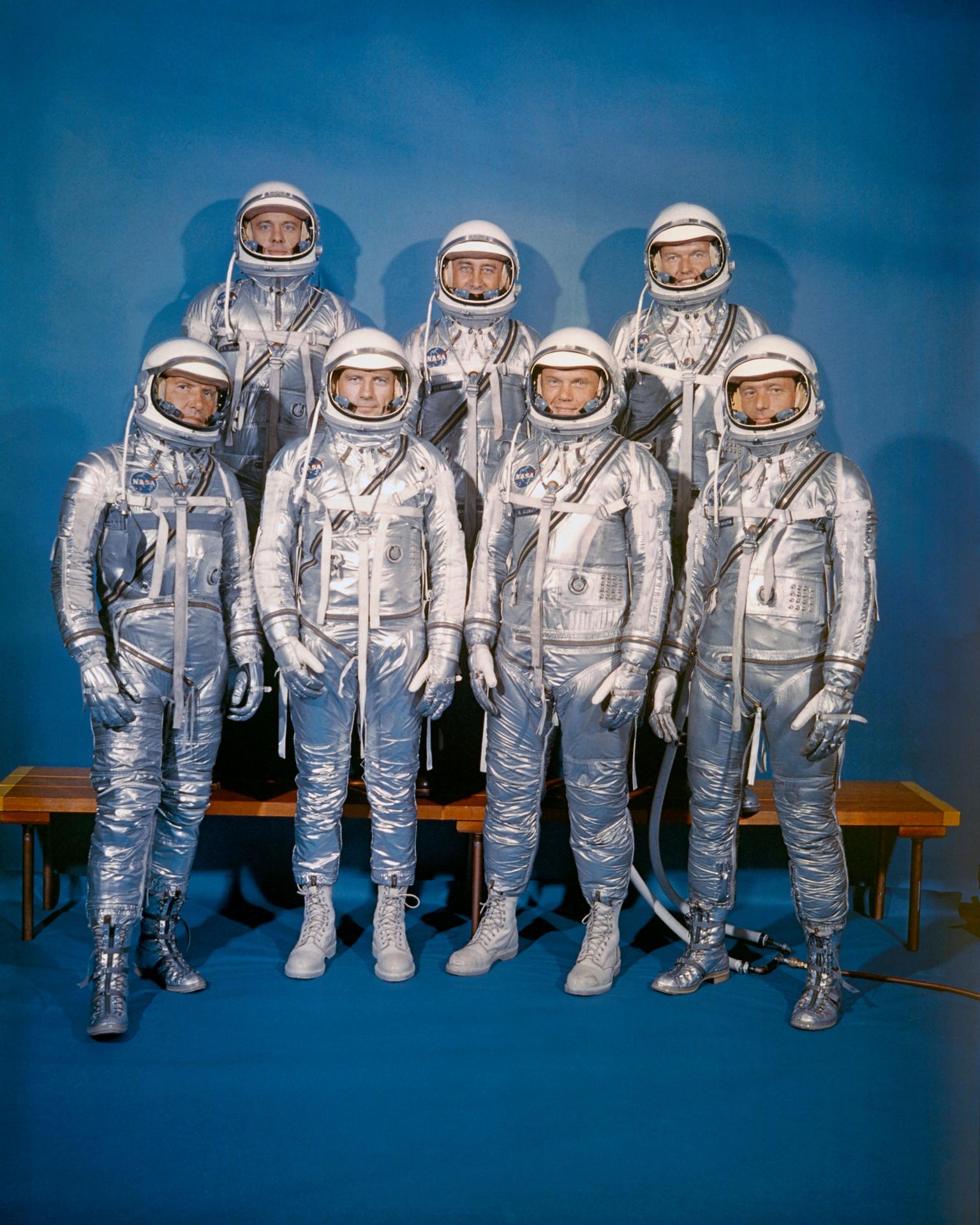
A few weeks later he became one of the “Original Seven” Mercury astronauts, chosen on April 9 1959, and was assigned to the Manned Spacecraft Center (then Space Task Group) at Langley Field, Virginia.8 Upon reporting for duty, he was assigned a specialty area in training involving communications and navigational aids, because of his extensive prior experience in that field in the Navy. He served as John Glenn’s backup pilot during pre-flight preparations for America’s first manned orbital flight, MA-6.9
When NASA grounded MA-7 pilot Donald K. Slayton (Deke) due to his heart condition, idiopathic atrial fibrillation (erratic heart rate), Carpenter was selected as prime pilot for that mission with Walter M. Schirra, Jr., as his backup pilot.10
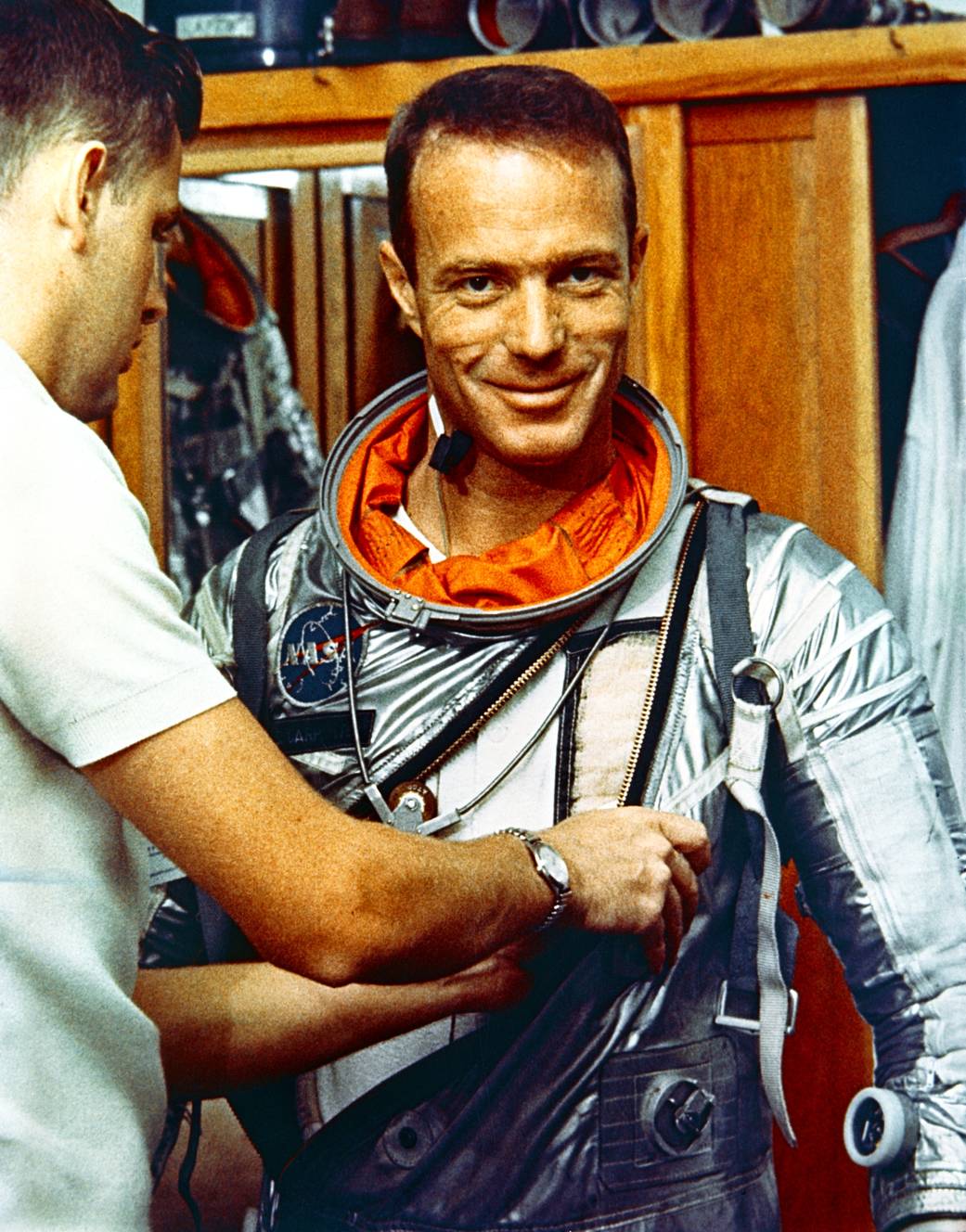
On May 24, 1962, Carpenter lifted off onboard the spacecraft he dubbed Aurora 7 sitting atop the Mercury-Atlas 7 rocket. His Aurora 7 spacecraft attained a maximum altitude (apogee) of 164 miles and an orbital velocity of 17, 532 miles per hour.11 His primary goal during the three-orbit mission was to determine whether an astronaut could work in space, a major stepping stone towards a lunar landing. The flight plan included numerous scientific experiments, including observations of flares fired on Earth and the deployment of a tethered balloon. The balloon deployment was an important experiment, to measure the drag of the balloon in the very thin atmosphere and observe its behavior, its distance from the capsule and the various colors it was painted. But the balloon did not inflate properly—it got only 10 inches wide instead of 30—and it took longer than was expected for it to reach the end of its 100-foot nylon tether. Carpenter was, however, able to judge its colors—the orange being the most visible, which was a clue NASA used for painting objects necessary for orbital rendezvous procedures. It was impossible for Carpenter to measure drag and the balloon proved to be extremely difficult to jettison once the experiment was concluded. The switch that was meant to release the balloon did not operate and Aurora 7 continued to trail the balloon until retro-fire.12 Needless to say, the mission was less than a total success. Carpenter seemed distracted and behind schedule most of the flight.13 He expended too much attitude-control fuel when he inadvertently neglected to shut off the straight manual system when he switched over to the fly-by-wire system in which the pilot could control the capsule himself using fuel from the automatic system tanks rather than the manual system tanks. As a result he was draining fuel out of both systems every time he used the stick.14
At the time of retro-fire, Carpenter believed that he had brought the capsule to the proper attitude. He found out later that this was not correct. The small bottle-top end of the capsule was canted 25 degrees to the right of where it should have been, an error in yaw. He was unable to line the capsule up on all three axes as precisely as he should have. This meant that the capsule was not pointed in an absolute straight line long its path when the rockets fired, and so it did not slow down as much as it should have. This accounted for 175 miles of the 250-mile overshoot. But, several other things went wrong in addition to that. First, the retrorockets did not deliver the full thrust that was expect of them. This loss of thrust accounted for 60 miles of the overshoot. And then, on top of all this, the three retros fired approximately three seconds late. They were designed to fire automatically, but they did not. Carpenter watched the clock pass the correct instant, and then hit the retro-button himself a second later. Two seconds passed before they finally went off. At the speed of 5 miles per second, this lapse of three seconds accounted for another 15 miles in the overshoot. In between the time when the retrorockets were fired and the moment the Aurora 7 began its reentry through the atmosphere, things were “pretty tight,” as Carpenter puts it. The fuel supply was critically low, and it was unclear as to whether or not there would be enough fuel to keep the capsule in the proper trim for the long glide back to Earth. If it came through at the wrong angle and the fuel was exhausted, Carpenter would have been unable to control the capsule during descent and the chances of surviving such a reentry were not good. He learned that though the manual tank still registered 7 percent, it was really empty, and only 15 percent of the fuel supply remained in the automatic tank for the whole reentry. He was dangerously short.15
Carpenter maneuvered the capsule very gingerly, keeping the horizon in view through the window, and trying to use as little fuel as possible. He held the position steady and when he felt the first oscillations that told him the capsule was encountering the heavy atmosphere, he started the capsule rolling at a rate of 10 degrees per second. This was to help keep it on its proper course on the way down and to equalize the heating of the spacecraft from the intense heat it would encounter during the reentry process.16
Despite worries it was a beautiful reentry. The ride most of the way down was smooth and Carpenter and his Aurora 7 spacecraft were headed in at a good angle. When he glanced out the window, Carpenter noticed an orange ring of fiery particles stretching out like a wake behind the capsule. These were tiny pieces of the ablative heatshield which had melted off and were carrying some of the intense heat away with them. The peak Gs last longer than they were expected to on the way down and as Carpenter spoke, he had to inhale more frequently. The oscillations were beginning to build up and he could feel them swinging the capsule from side to side. These, however, were welcome because they meant that an aerodynamic pressure would be exerted against the capsule and help keep it on an even keel on the way down. The G forces tapered off at 120,000 feet, and the capsule and Carpenter were falling approximately 600 miles per hour. The oscillations built up rapidly and carpenter used the very last of his fuel trying to control it, he was concerned that the capsule might topple over completely and start coming down topside first. If this were to happen the drogue parachute would get badly fouled up if it popped out during the wild swinging or possibly snap the capsule around so violently that the chute would be badly damaged during deployment.17
Finally, as the oscillations became worse and the capsule began to sway through a huge arc of about 270 degrees—almost a full circle—Carpenter pressed the button to deploy the drogue chute. This was at 26,000 feet. The flight plan originally called for the chute to be deployed automatically at 21,000 feet, however Carpenter felt it needed it sooner to help damp the oscillations. The six-foot drogue came out in good shape, and the descent stabilized. The altimeter swung towards 10,000 feet, the point at which the main chute was supposed to come out automatically. When it did not, Carpenter allowed 500 feet more and then pulled the ring. It deployed perfectly, an orange and white canopy, perfectly shaped, stressed to its limit and drawn tight as sheet metal as it strained to support the capsule’s weight.18
Carpenter had no way of knowing that he had overshot his landing target area by 250 miles. He had experienced the normal communications black-out during reentry as the ionization barrier built up around the capsule, and neither the Cape nor Carpenter could hear each other. Once Aurora 7 past that phase of reentry, Carpenter picked up a transmission from Gus Grissom, second American in space and capsule communicator (CAPCOM) at the Cape Canaveral Control Center. He advised Carpenter that he had overshot his target area and that he should expect to wait approximately an hour on the water for recovery. Grissom also informed him that a plane carrying paramedics was on its way to the landing area to give him assistance. The tracking devices had computed Carpenter’s landing point as he descended, so the Control Center knew fairly well where he was, but it was clear that he had overshot by so far that he was out of range of the communications network.19
Most of NASA’s communications between the capsule and the ground were made on a line-of-sight basis. As long as the capsule was at orbital altitude, the radio transmissions carried easily to the next tracking station. However, the lower the capsule became, the shorter the range of communications became until when Carpenter reached parachute level at 2,000 feet, there was no one close enough to hear him. He did pick up signals from the stronger ground transmitters, which is how he heard Grissom’s transmissions, but his were too weak for anyone to read. He made several calls as he parachuted down, but when no answer was received he knew that no one could read his transmissions.20
Upon landing after 4 hours 53 minutes and 47 seconds of flight,21 the capsule became completely submerged and emerged listing sharply—about 60 degrees—to one side. He saw a small amount of water in the cockpit; the tape recorder at his feet had several splashes on it. With an hour to wait for recovery, Carpenter decided to get out and wait in the raft. He removed his helmet, removed the right half of the instrument panel to make an exit and then squeezed his way up past the instrument panel. It was not an easy exit but he found it better than sitting in the listing capsule for an hour or blowing the side hatch and losing the spacecraft altogether. He opened the hatch on the small end of the craft, put the camera he had been using during the mission in a safe place near the opening and dropped the life raft into the water. He got onto it before he realized that it was upside down. He climbed out into the water, turned the raft over and got back in. Then he tied the raft to the capsule so they wouldn’t drift apart and turned on the SARAH (Search And Rescue And Homing) beacon which would assist the recovery plane home in on his position.22
Approximately 45 minutes after his splashdown, 1000 miles southeast of the Cape,23 recovery planes from the USS Intrepid began approaching. He signaled them with a small hand mirror and they began to circle his position. Not long after that, there were planes all around his landing area. Two paramedics jumped into the ocean and proceeded to attach a collar to the capsule to keep it afloat and checked on the astronaut. Carpenter offered them food and water from his survival kit, grateful for their presence.24 It was another two hours before a helicopter from the USS Intrepid could pick up the astronaut. Almost an hour and a half later, the second American astronaut to orbit the earth stepped out onto the deck of the Intrepid to be taken back to Grand Turk Island for debriefing.25 Following his space flight and subsequent debriefing, Carpenter returned to Patrick Air Force Base at Cocoa Beach, Florida, and was faced with a round of honor-receiving ceremonies.26
It is believed that because of his performance, Carpenter was told that he would never fly another NASA mission.27 In 1963, he monitored the design and development of the lunar module for the Apollo project. He also served temporarily as Executive Assistant to the Director of the Manned Spaceflight Center in Houston. In the spring of 1965, on leave from NASA, he participated as an aquanaut in the U.S. Navy’s SEALAB II project. In this capacity, he acted as Training Officer for the crew and was Officer-in-Charge of the submerged diving teams during the operation.28 He spent 30 days living and working in SEALAB II 205 feet below the surface on the ocean floor off the coast of La Jolla, California. At one point he spoke by phone to the crew of Gemini 5, original Mercury astronaut L. Gordon Cooper and “New Nine” astronaut Charles L. “Pete” Conrad, orbiting overhead. Carpenter led two of three teams of Navy men and civilians during the 45-day experiment.29 For his participation in the experiment, he was awarded the Navy’s Legion of Merit award.30
NASA public relations credited Carpenter with being the first person to explore both of humanity’s great remaining frontiers, the ocean and President Kennedy’s “New Ocean”: space. After the SEALAB II experiment, Carpenter returned to the space program and was responsible for liaison with the Navy for underwater zero-gravity training (neutral buoyancy).31 On July 16, 1964, in Hamilton, Bermuda, Carpenter lost control of the motorcycle he was driving and broke his lower left arm. The compound fracture eliminated Carpenter from participation in a Navy test in which he would have been submerged in a diving chamber with four Navy divers at a depth of 192 feet.32 This accident also removed him from flight status and he resigned from NASA on August 10, 1967.33
He was then assigned to the Navy’s Deep Submergence Systems Project as assistant for aquanaut operations during the SEALAB III experiment. The project was responsible for developing deep-ocean search, rescue, salvage and ocean engineering capabilities, and directed the Navy’s Saturation Diving Program.34
Carpenter retired from the Navy on July 1, 1969. Since then he has been an engineering consultant, a wasp breeder, and a novelist. His first novel, entitled The Steel Albatross, is a techno-thriller in the same vein as Tom Clancy, about a Soviet plot to place a doomsday device on the ocean floor. He still makes his home in Colorado, his boyhood home, and is still friends with the remaining Mercury astronauts. They occasionally get together for skiing trips or meetings in connection with their Florida-based Mercury 7 Foundation for scholarships in space education.35
Carpenter is 5 feet 10 inches tall and weighs 160 pounds. He has brown hair and green eyes. He was married to the former Rene Louise Price of Clinton, Iowa, on September 9, 1948; they were later divorced. He married the former Maria Roach, daughter of film producer Hal Roach, in 1972, and married the former Barbara Curtin in 1988. They have since divorced. He has four children from his first marriage: Marc Scott, born November 29, 1949; Kristen Elaine, born June 26, 1955; Candace Noxon, born October 8, 1956; and Robyn Jay, born March 4, 1962. He also has two children from his second marriage: Matthew Scott and Nicholas Andre, and one child from his third marriage: Zachary Scott. 36
Carpenter is an honorary fellow in the Institute of Environmental Sciences, a member of the Association of Space Explorers–USA, and a member of Delta Tau Delta. He has been awarded the Legion of Merit, Distinguished Flying Cross, NASA Distinguished Service Medal, Navy Astronaut Wings, University of Colorado Recognition Medal, National Aeronautic Association’s Collier Trophy, New York City Gold Medal of Honor, Elisha Kent Kane Medal, Boy Scouts of America Silver Buffalo, and Numismatica Italiana Award.
Additional information about Carpenter, including his official NASA biography.
Notes
- Hawthorne, Douglas B. Men and Women of Space (San Diego, California: Univelt Incorporated, 1992), pp. 119–120.
- “Malcolm Scott Carpenter.” National Aeronautics and Space Administration (Washington, DC, May 1961). Hereafter referred to as NASA Biography.
- Ibid.
- “M. Scott Carpenter.” Manned Spacecraft Center Biographical Data. Houston, Texas, April 1967, p. 1. Hereafter referred to as MSC Biography.
- NASA Biography.
- Hawthorne, p. 120.
- Ibid.
- MSC Biography, p. 2.
- Ibid.
- “Carpenter Replaces Slayton as MA-7 Pilot.” NASA Press Release. Washington, DC, March 15, 1962.
- MSC Biography, p. 2.
- Carpenter, M. Scott, et al. We Seven (New York: Simon and Schuster, 1962), p. 359.
- Hawthorne, p. 121.
- Carpenter, et al., pp. 362–363.
- Ibid., pp. 363–364.
- Ibid., p. 364.
- Ibid., pp. 364–365.
- Ibid., p. 365.
- Ibid., pp. 365–366.
- Ibid., p. 366.
- MSC Biography, p. 2.
- Carpenter, et al., pp. 366–367.
- MSC Biography, p. 2.
- Carpenter, et al., p. 368.
- “Three More Orbits Added to Record.” Space News Roundup 30 (May 1962): 1, 3.
- “Astronaut M. Scott Carpenter, Aurora 7, May 24, 1962.” National Aeronautics and Space Administration Manned Spacecraft Center. Houston, Texas, p. 1.
- Hawthorne, p. 121.
- MSC Biography, p. 2.
- Hawthorne, p. 121.
- MSC Biography, p. 2.
- Hawthorne, p. 121.
- “Motor Bike Spill Fractures Arm of Astronaut.” The Baltimore Sun, July 17, 1964.
- Ibid.
- Ibid.
- Ibid.
- Hawthorne, p. 120 and e-mail from Barbara Carpenter, July 16, 2001.
by Tara Gray
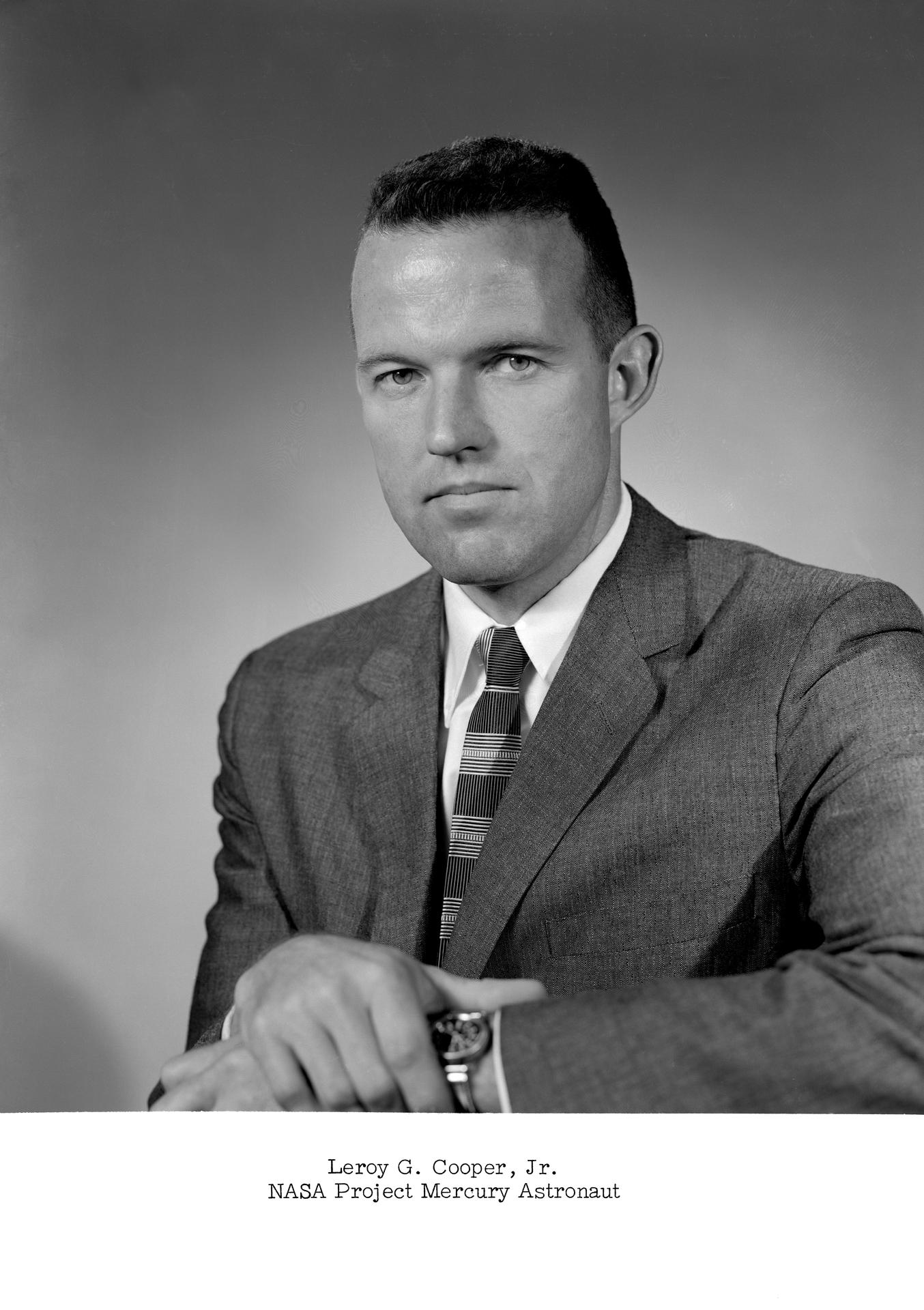
Leroy Gordon Cooper, Jr. (Colonel, USAF, Ret.), was born on March 6, 1927, in Shawnee, Oklahoma, to parents Leroy Gordon Cooper, Sr. (Colonel, USAF, Ret.) and Hattie Lee (Herd) Cooper. He attended primary and secondary schools in Shawnee, and Murray, Kentucky, where he graduated from high school in 1945.1 The Army and Navy flying schools were not taking any candidates the year he graduated from high school so he decided to enlist in the Marine Corps. He left for Parris Island as soon as he graduated. World War II ended, however, before he could get into combat. He was assigned then to the Naval Academy Preparatory School and was an alternate for an appointment to Annapolis. The man who was the primary appointee made the grade so Cooper was reassigned in the Marines on guard duty in Washington, D.C. He was serving with the Presidential Honor Guard in Washington when he was released from duty along with other Marine reservists. After his discharge from the Marine Corps, he went to Hawaii to live with his parents. His father was assigned to Hickham Field at the time. He started attending the University of Hawaii, and there he met his first wife, the former Trudy B. Olson of Seattle, Washington. She was quite active in flying, the only Mercury wife to have a pilot’s license. They were married on August 29, 1947, in Honolulu and lived there for two more years while he continued his studies at the University.2
While he was at the University he received a commission in the U.S. Army ROTC. He transferred to the Air Force and was called to active duty for flight training on the main continent in 1949. He underwent pilot’s training at Perrin Air Force base, Texas, and Williams Air Force Base, Arizona. In 1950, after he received his wings, he was assigned to the 86th Fighter Bomber Group at Landstuhl, West Germany, where he flew F-84 and F-8 jets for four years. He later became flight commander of the 525th Fighter Bomber Squadron. While in Germany he attended the European extension of the University of Maryland night school for a year.3
When he returned to the U.S. in 1954 he attended the Air Force Institute of Technology at Wright-Patterson Air Force Base in Dayton, Ohio, for two years. He graduated there with a bachelor’s degree in aeronautical engineering in August 1956, and was assigned to Edwards Air Force Base, California, where he attended the Experimental Flight Test School until 1957. When he graduated from the school he was assigned to the Fighter Section of the Flight Test Engineering Division at Edwards as a project engineer and test pilot at the Air Force Flight Test Center.4 There he worked on the F-102A and the F-106B test programs. He corrected several deficiencies in the F-106, saving the Air Force a great deal of money.5
While at Edwards he read an announcement that the McDonnell Aircraft Corporation in St. Louis had been awarded a contract to build a space capsule. This really interested Cooper. He soon found out the Project Mercury was interested in him, too. A few days after he read the announcement about the new capsule, he was called to Washington, D.C. for a briefing. NASA engineers spent an entire morning giving the 110 invited military test pilots a technical rundown on Project mercury and what the astronauts’ part in it would be. The pilots were asked later in the day to give their reactions to what they had seen and heard, and to indicate whether or not they were interested. Cooper replied that he was definitely sold on the program and that he very much wanted to become an astronaut.6
First, the candidates had to take several series of technical and psychological tests, followed by physical examinations at the Lovelace Clinic in Albuquerque, New Mexico. The candidates then flew to Wright-Patterson for a round of psychological or stress tests. The candidates were isolated, vibrated, whirled, heated, frozen, fatigued and run to high altitudes. In the end, Cooper felt that he had done very well. In fact, he had every confidence when he returned to Edwards that he would make the team. He told his boss to start looking for a replacement and he alerted his family to be ready to move. He took two weeks’ leave to get ready to pull up stakes and move to Langley, Virginia, home of the NASA Space Task Group and Project Mercury. Cooper felt very confident and intended to be ready. He was not surprised when the phone call came two days after he had returned from leave. Charles Donlan, associate director of Project Mercury, welcomed Cooper to the team and asked when he could leave for Langley. Cooper replied, “How about right now?”7
On April 9, 1959, NASA announced to the public their selections for the Project Mercury astronauts. Along with Cooper at the press conference in Washington, D.C. sat Alan B. Shepard, Jr., Virgil I. “Gus” Grissom, John H. Glenn, Jr., M. Scott Carpenter, Walter M. Schirra, Jr. and Donald K. “Deke” Slayton. Once the selections and announcements had ended, the astronauts began their training program at Langley. This included a “little of everything” ranging from a graduate-level course in introductory space science to simulator training and scuba-diving. Training continued until the Langley Space Task Force was transferred to Houston, Texas.8 When each of the Mercury astronauts were assigned a different portion of the project and special assignments, to ensure pilot input, Cooper specialized in the Redstone rocket. The Redstone was already well-proven when it was first considered for use in Project Mercury. However, it had to be made compatible with the Mercury spacecraft and this took some close coordination and communication between several different agencies. Assigning an astronaut to help accomplish this paid off, for several reasons. To begin with, Cooper was a military man who had been assigned to a civilian agency, so he could understand the problems on both sides. As an engineer, he could talk the language of the other engineers. And, since he planned to ride the finished product himself, he could really become immersed in the problems.9
Like everyone else on the team, Cooper also had several development tasks in addition to his own regular astronaut training. One of these was the development of a personal survival knife which the astronauts wanted to carry in the capsule with them. They all knew from their experience as pilots that a knife is one of the most valuable tools for survival on both land and water, and they also knew that they would encounter a good deal of both of these elements during their flights. They would be orbiting over oceans and jungle and desert, and they wanted to be prepared for any emergency. Another task that Cooper was responsible for was to serve as chairman of an Emergency Egress Committee which was responsible for working out procedures for saving the astronaut in the event of an emergency on the pad.10 He served as capsule communicator (CAPCOM) for Mercury MA-6, John Glenn’s first orbital flight in Friendship 7, and MA-7, Scott Carpenter’s flight in Aurora 7. He also served as backup pilot for MA-8, Wally Schirra’s mission in Sigma 7.11
Cooper’s first flight began on May 15, 1963, when he was launched as the pilot of MA-9, the last Mercury mission. Cooper, in his Faith 7 capsule, orbited the Earth 22 times and logged more time in space than all five previous Mercury astronauts combined. His primary objectives were to evaluate the effects of a lengthier stay in space on man and to verify man as the primary spacecraft system. During the mission, he became the first American astronaut to sleep in orbit.12 His mission lasted 34 hours, 19 minutes and 49 seconds, during which he completed 22 orbits and traveled 546,167 miles at 17,547 miles per hour and pulled a maximum of 7.6G’s. He achieved an altitude of 165.9 statute miles at apogee (highest point in orbit) and 100.3 statute miles at perigee (lowest point in orbit).13
Two years later, Cooper was launched as the commander of Gemini GT-5 with Charles “Pete” Conrad, Jr., as the pilot, making Cooper the first person to make a second orbital flight. The eight-day mission, which began on August 21, 1965, proved that astronauts could survive in space for the time it took spacecraft to go from the Earth to the moon and back. Cooper and Conrad also evaluated the performance of rendezvous guidance and navigation systems using a rendezvous evaluation pod. The mission was successful except for a rendezvous failure due to a fuel-cell heater problem. On August 29, the last day of the flight, Cooper and Conrad communicated by radio with Mercury astronaut Scott Carpenter aboard SEALAB II, which was 205 feet underwater off the coast of La Jolla, California.14 The mission lasted 7 days, 22 hours, 55 minutes and 14 seconds, 120 orbits were completed at an altitude of 349.8 kilometers and the crew landed on August 29, 1965, recovered by the USS Champlain.15
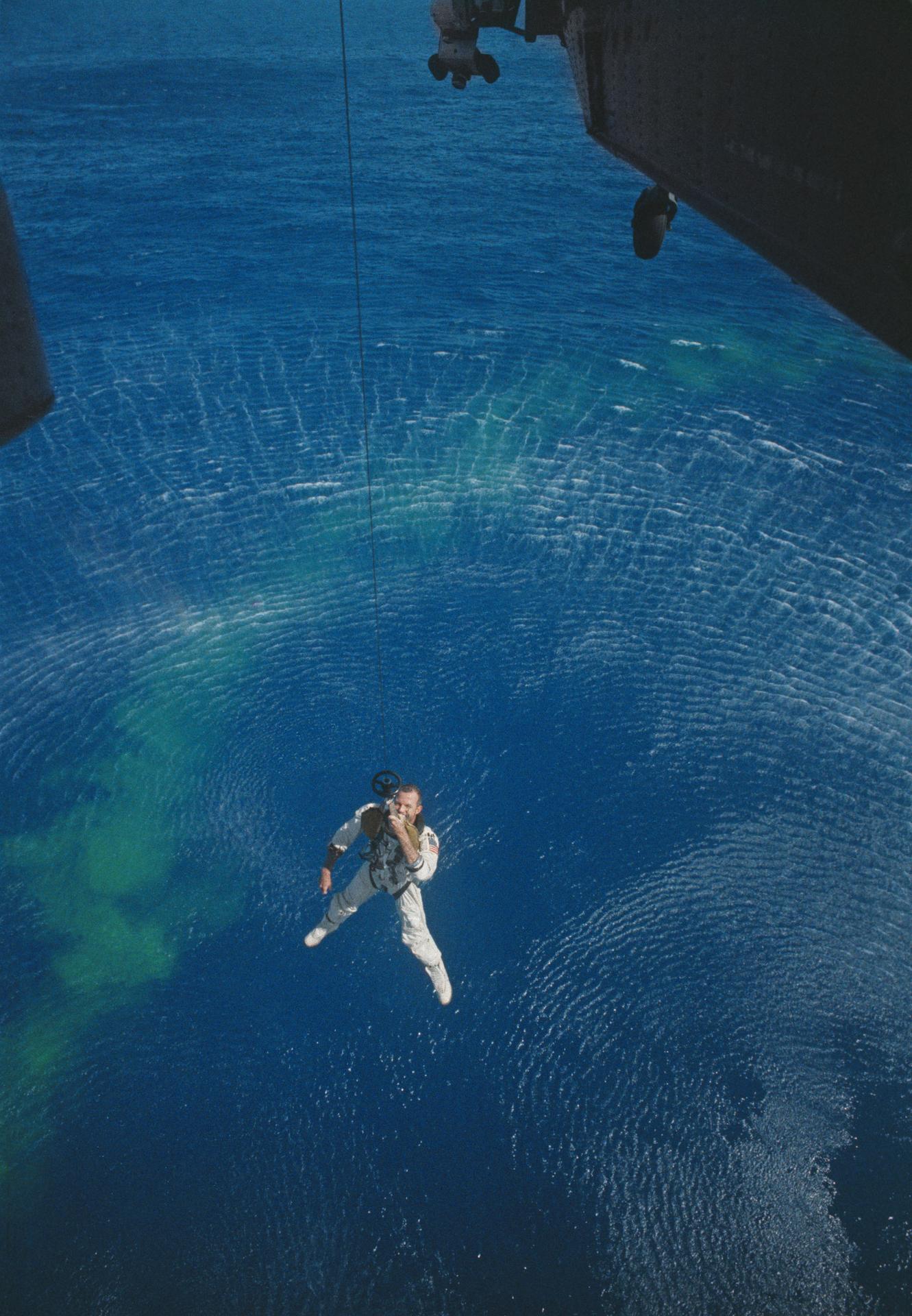
During his two spaceflights, Cooper logged 225 hours, 15 minutes and 3 seconds. He served s the backup commander for Gemini GT-12, the last Gemini mission, and as the backup commander for Apollo 10. In July 1969, he was in line to be named commander of Apollo 13, a lunar landing mission scheduled for April 1970. In a reshuffling of assignments, Cooper was replaced on Apollo 13 by Alan Shepard, who had recently been returned to flight status after a four-year hiatus due to an inner ear condition. Shepard was later moved to the command position of Apollo 14 and the Apollo 13 command position was given to James A. Lovell.16
Following the conclusion of the Gemini program, Cooper was assigned to important tasks in the Apollo and Apollo Applications Program (which later evolved into the Skylab program) as assistant to Deke Slayton, then crew operations chief for Skylab. He resigned from NASA and the Air Force, at the rank of Colonel, on July 31, 1970, to become a Washington business executive.17 After leaving NASA he formed Gordon Cooper and Associates, Incorporated, an aviation and aerospace consulting firm based in Hialeah, Florida. From 1974 to 1980, he was vice president for research and development for Walter E. Disney Enterprises Incorporated, based in Glendale, California. Since leaving the space program, Cooper has been on the boards of directors of and a technical consultant to a number of companies in the aerospace, electronics and energy fields. Since 1980, he has been president of X=L Incorporated, a firm that develops alcohol-based aviation fuel.18
Cooper has brown hair and brown eyes. He stands 5 feet 8 inches tall and weighs 155 pounds.19 After divorcing his first wife, Cooper later remarried to the former Suzan Taylor on May 6, 1972. He has four daughters, Camala Keoki (Cooper) Thorpe, born on November 16, 1948, and Janita Lee (Cooper) Stone, born on March 15, 1950, both from his first marriage. From his second marriage he has Elizabeth Jo and Colleen Taylor.20
Cooper has earned numerous honors and awards including; an honorary Doctorate of Science from Oklahoma City University, in 1957; the Air Force Legion of Merit; the Air Force Distinguished Flying Cross with one oak leaf cluster; the NASA Exceptional Service Medal; the NASA Distinguished Service Medal, on May 21, 1963; Air Force Command Pilot Astronaut Wings, on May 29, 1963; Air Force Command Missileman’s Badge; National Aeronautic Association’s Robert J. Collier Trophy, for 1962; Harmon International Trophy, for 1963; Scottish Rite 33 Degrees; York Rite Knight of the Purple Cross; DeMolay Legion of Honor; John F. Kennedy Trophy; Iven C. Kincheloe Award, for 1963; Air Force Association Trophy; Primus Trophy; John Montgomery Trophy; General Thomas D. White U.S. Air Force Space Trophy; Association of Aviation Writers Award; University of Hawaii Regents Medal; Columbus Medal; Silver Antelope; and the Sport Fishing Society of Spain Award.21 He is a member of the Society of Experimental Test Pilots, American Institute of Aeronautics and Astronautics (AIAA), American Astronautical Society (AAS), Blue Lodge Masons, York Rite Masons, Scottish Rite Masons, Shriners, Royal Order of Jesters, Sojourners, Rotary Club, Quiet Birdmen, Order of Daedalians, Confederate Air Force, Boy Scouts of America and Girl Scouts of America.22
Cooper died on October 4, 2004, at his home in Ventura, California. He was 77 years old.
Additional information about Cooper, including his official NASA biography.
Notes
- Hawthorne, Douglas B. Men and Women of Space (San Diego, California: Univelt Incorporated, 1992), p. 160.
- Carpenter, M. Scott, et al.We Seven (New York: Simon and Schuster, 1962), p. 52.
- Hawthorne, p. 161.
- Carpenter, et al., pp. 52–53.
- Hawthorne, p. 161.
- Carpenter, et al., pp. 53–54.
- Ibid., pp. 54–55.
- “John Glenn.” John Glenn Biography, 1998. http://muskingum.edu/~publicr/history/glenn.html (July 8, 1998), p. 1. Hereafter referred to as John Glenn.
- Carpenter, et.al., p. 86.
- Ibid., pp. 87–88.
- Hawthorne, p. 161.
- Ibid., pp. 161–162.
- Dumoulin, Jim. “MA-9 (26).” NASA Project Mercury Mission MA-9, 1997. http://www/ksc.nasa.gov/history/mercury/ma-9/ma-9.html (August 11, 1998), pp. 1–2.
- Hawthorne, p. 162.
- Dumoulin, Jim. “Gemini-V (5).” NASA Project Gemini-V, 1998. http://www.ksc.nasa.gov/history/gemini/gemini-v/gemini-v.html (August 4, 1998), pp. 1–2.
- Hawthorne, p. 162.
- “Cooper Leaving NASA.” NASA Press Release, June 23, 1970, p. 1.
- Hawthorne, p. 162.
- Ibid., p. 161.
- Ibid., p. 160.
- Ibid., pp. 160–161.
- Ibid., p. 160.
by Tara Gray
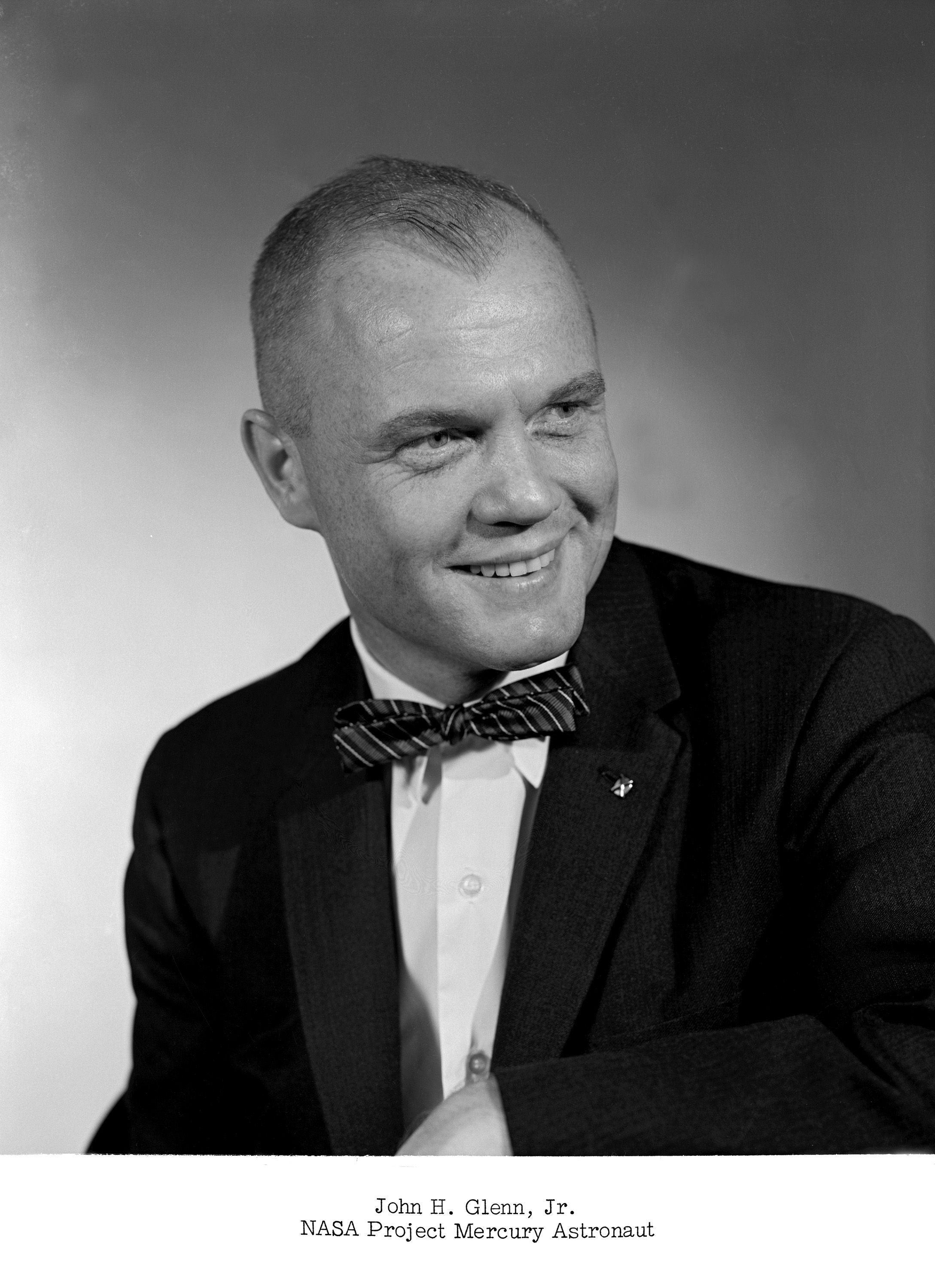
John Herschel Glenn, Jr., Colonel USMC (Ret.), was born on July 18, 1921, in Cambridge, Ohio. He grew up in New Concord, Ohio, where he attended school and graduated from New Concord High School. He then enrolled in New Concord’s Muskingum College where he received a B.S. in engineering.1 He had already learned to fly at the small New Philadelphia airfield through a government civilian pilot training program to let young men start learning how to fly while they were completing their education.2 He took the Army Air Corps physical examination, passed it and was sworn in. However, when no orders came he took the Navy’s physical, which he also passed and was sworn into the Naval Aviation Cadet Program.3 His orders came right away and he left for training. He went to the University of Iowa for preflight training and then continued on to Olathe, Kansas, for primary training. He finished up with advanced training in Corpus Christi, Texas. While at Corpus Christi, he learned that he could volunteer for duty in the Marine Corps and receive a commission in the Marines rather than the Navy. He won his wings and lieutenant’s bars in 1943,4 and on April 6 of that year, he married the former Anna Margaret Castor, daughter of Dr. and Mrs. H.W. Castor of New Concord.5
After a year of training, Glenn joined Marine Fighter Squadron 155 and spent a year flying F4Us in the Marshall Islands in the South Pacific flying 57 combat missions.6 During his World War II service Glenn flew 59 combat missions. He then returned home to help train other pilots and do some test-pilot work at Patuxent River, Maryland, putting new planes through simulated combat missions.7 While Glenn was stateside, the war ended. Upon the end of WWII, Glenn joined Fighter Squadron 218 on North China patrol and had duty on Guam. From June 1948 until December 1950 Glenn was an instructor in advanced flight training at the Corpus Christi Naval Air Station. He then attended Marine Amphibious Warfare Training at Quantico, Virginia.8
By this time the Korean conflict had begun and Glenn requested combat duty.9 He flew F9F Panther jets for 63 ground-support missions10 with Marine Fighter Squadrons 311 and 27.11 Later, he was assigned as an exchange pilot with the Air Force in F-86 Sabrejets . In combat duty during the last nine days of fighting in Korea, Glenn shot down three MiGs along the Yalu River. For his service in 149 missions in two wars, he received numerous honors, including the Distinguished Flying Cross (six occasions) and the Air Medal with eighteen clusters.12
After Korea, Glenn applied for duty at the Navy Test Pilot School at Patuxent River and was accepted. While attending there he helped to test most of the Navy’s new jets, particularly fighters.13 After graduation, he was project officer on a number of aircraft. He was assigned to the Fighter Design Branch of the Navy Bureau of Aeronautics (now Bureau of Naval Weapons) as a test pilot on Navy and Marine Corps jet fighters in Washington, D.C., from November 1956 to April 1959, during which time he also attended the University of Maryland.14 In July 1957, while project officer of the F8U, he set a transcontinental speed record of 3 hours, 23 minutes and 8.4 seconds from Los Angeles to New York.15 This was the first transcontinental flight to average supersonic speeds.16
Project Mercury
While on duty at Patuxent and Washington, Glenn began to learn more and more about space. He read everything he could find on the subject and kept his eyes and ears open. His office was asked to furnish a test pilot to visit the NASA Laboratory at Langley Air Force Base in Virginia and make some runs on one of the spaceflight simulators as a part of a NASA investigation of various reentry shapes. The same officer would go on from Langley to the Naval Air Development Center at Johnsville, Pennsylvania, to make runs on the large centrifuge there in order to compare data obtained from the simulator with data obtained from the centrifuge while under high G forces.17 Glenn requested and was given this assignment. He spent a few days at Langley and over a week in Johnsville, where he helped work out a mission on the centrifuge that simulated the conditions a pilot would go through as he made a re-entry from space.18
He was also involved in helping to design the Mercury capsule. NASA requested service participation in drawing up the plans for the mock-up of the capsule, which it was already considering, pending selection of the Astronauts. Because of his participation in the Langley/Johnsville project, his sitting on a number of mock-up boards in the Navy and his knowledge of the procedures, it was arranged for Glenn to go to the McDonnell plant in St. Louis, where the capsule mock-up was being discussed and act as one of the service advisors to the mock-up board.19
It was at this point that Glenn decided to begin trying to get into this program. Space travel was at the frontier of his profession and it was only natural that he want to be in on it.20 The Manned Space Program began in 1958 and by 1959, when the screening of the military test pilots was completed, Glenn’s name was on the list of those who met the minimum requirements, along with over 100 others.21 This list was pared down through several screenings until Glenn was one of 32 prospective astronauts—along with Scott Carpenter, Gordon Cooper, Gus Grissom, Wally Schirra, Alan Shepard, Deke Slayton, and 25 other pilots. NASA asked these pilots to take a series of tests which help to narrow the group further. Some of these tests were physical tests, to measure exactly how much stamina each pilots had, while other tests were psychological, to measure maturity and alertness and see what motivated each of the prospective astronauts.22 Following the intensive rounds of testing the pilots had a waiting period of ten to twelve days. During that time Glenn returned to his position at the Navy Bureau of Aeronautics in Washington. While there he received a call from Mr. Charles Donlan, the associate director of Project Mercury, asking him if he was still interested. Glenn replied that he was and Donlan informed him that he had been selected as a Mercury astronaut.23
Once selected, the astronauts began their training program at Langley. This included a “little of everything” ranging from a graduate-level course introductory space science to simulator training and scuba-diving. Training continued until the Langley Space task Force was transferred to Houston, Texas.24 When each of the Mercury astronauts were assigned a different portion of the project and special assignments, to ensure pilot input, Glenn specialized in the instrument panel layout, cockpit design and control functioning, including some of the early designs for Project Apollo.25
Prior to his flight Glenn served as backup pilot for Astronauts Shepard and Grissom. After eleven delays, due in part to equipment malfunctions or improvements and weather, he launched from Cape Canaveral (renamed Kennedy) and made America’s first orbital flight on February 20,1962, piloting the Mercury-Atlas 6 Friendship 7 spacecraft on the first manned orbital mission of the United States.26 Near the end of the first orbit the automatic control system wasn’t functioning properly. He went to manual control and continued in that mode during the second and third orbits and during re-entry. Another problem that Glenn encountered involved a signal sent to the ground via telemetry indicating that his spacecraft, Friendship 7, had a loose heat shield. In order to make sure it was secured in place during re-entry, the retropack was kept in place to steady the shield.27 During re-entry large portions of the burning retropack flew by the window but by that point there was sufficient aerodynamic force on the shield to hold it in position.28
His flight lasted 4 hours 55 minutes and 23 seconds and reached a maximum altitude (apogee) of approximately 162 statute miles, a minimum altitude (perigee) of 100 statute miles and an orbital velocity of approximately 17,500 miles per hour.29 He pulled a maximum of 7.7 Gs and traveled a total distance of 75,679 statute miles.30 Glenn’s Friendship 7 Mercury spacecraft landed in an area in the Atlantic approximately 800 miles southeast of Cape Canaveral in the vicinity of Grand Turk Island. He landed 41 miles west and 19 miles north of the planned landing target.31 Glenn and his spacecraft were recovered by the destroyer USS Noa. Lookouts on the destroyer spotted the main parachute at an altitude of 5,000 feet from a range of 5 nautical miles. The Noa had the spacecraft aboard 21 minutes after landing and Glenn remained in the spacecraft during the recovery operation. Original plans had called for egress through the top hatch but Glenn was becoming uncomfortably warm and it was decided to exit by the easier side hatch egress path.32
Glenn returned to the U.S. for a tremendous hero’s welcome. President John F. Kennedy flew to Cape Canaveral to meet him. Glenn’s family joined him there, too, and after a ceremony at which the President presented him with the Space Congressional Medal of Honor, Glenn took his wife and children up to the capsule—which had also been brought back to the Cape—and showed them how well it had sustained the flight. Then there were more celebrations, including a thunderous welcome in Washington and the traditional ticker-tape parade up Broadway in New York.33
Life after Mercury
Because of his age, 42, it became unlikely that Glenn might eventually take part in a lunar landing. Glenn resigned from the Manned Spacecraft Center on January 16, 1964 and the next day he announced plans to run for the Democratic nomination for the Senate in Ohio. On February 26, 1964, a bathroom rug slipped under him in his Columbus, Ohio, apartment, and Glenn fell, striking his head on the tub. He received a concussion which affected his inner ear balance.34 This injury produced swelling and bleeding which upsets the delicate and sensitive equilibrium mechanism. Glenn suffered from persistent and disabling symptoms of dizziness, nausea and a ringing noise which markedly restricted his physical movements.35 Weeks went by and his recovery remained slow. Doctors barred active campaigning. Supporters believed that he may have won the 5 May primary even without campaigning. However, on March 30, Glenn withdrew from the Senate race.36 He then went on convalescent leave from the Marine Corps in order to make a full recovery.37 He said he had decided to retire from the Marines when his retirement was acceptable. He could not retire until he passed his physical examination or his condition became static.
He was promoted to the rank of Colonel by the Marine Corps on October 27, 196438 and after 23 years of distinguished service to his country, Glenn retired from the Marines on January 1, 1965.39 In February 1965, he was named as a consultant to the NASA administrator and remained based in Houston, Texas. For the next five years, Glenn worked primarily as an executive with Royal Crown International, a soft drink company based in Atlanta, Georgia. He also served in the boards of several other corporations and made investments in hotel developments. When the aging Senator Stephen M. Young announced his intention to retire from politics in 1970, Glenn again announced his candidacy for Young’s Senate seat. Glenn’s campaign was badly organized and underfunded, and he was defeated. He learned from the defeat, however. He remained with Royal Crown until he won his seat in the U.S. Senate in November 1974 carrying all 88 counties of Ohio and was re-elected in 1980 with the largest margin in Ohio history. In 1983, he announced his intention to gain the Democratic presidential nomination in 1984. But, his campaign, like his 1970 Senate campaign, was considered by observers to be inefficient and unfocused. He dropped out of the race prior to the convention.40 Ohioans returned him to Senate for a third term in 1986, again with a substantial majority. In 1992, Glenn again made history by being the first popularly elected Senator from Ohio to win four consecutive terms.41 As a member of the 105th Congress, he is the Ranking Member of both the Governmental Affairs Committee and the Subcommittee on Airland Forces in the Senate Armed Services Committee. He also serves on the Select Committee on Intelligence and the Special Committee on Aging. He is considered one of the Senate’s leading experts on technical and scientific matters, and is widely respected for his work to prevent the spread of weapons of mass destruction.42
In the spring of 1997, Glenn returned to his alma mater and from the pulpit of Muskingum College’s chapel announced to the country that he would retire from the Senate at the end of his current term. He emphasized that his public service was not ending and that he would seek ways to remain active. He expressed his interest in returning to space flight and offered himself for a mission that might serve to investigate the issue of aging.43
On January 16, 1998, NASA Administrator Dan Goldin announced the appointment of John Glenn as a member of the crew of the Space Shuttle Discovery for mission STS-95, scheduled for October 29, 1998. He served as a payload specialist and a subject for basic research on how weightlessness affects the body of an older person.44 Glenn was a test subject for what is an expanded effort by NASA and the National Institute on Aging (NIA) to study the aging process in older persons. At 77 years of age, Glenn was the oldest astronaut to fly in space, nearly twice the age of the average astronaut. He was assigned several areas of personal basic research, with monitoring to occur pre-flight, in-flight, and post-flight, along with other bio-research projects involving all crew members.45 Glenn was involved in two age-related experiments, as both a researcher and a guinea pig. One studied the way certain proteins are processed during weightlessness, in the hope that researchers will gain hints about what causes muscle weakening in space. The other looked into sleep patterns by comparing the circadian rhythm, or biological clock that governs alertness and sleepiness, between Glenn and the others in the crew.46 Glenn was also in charge of the flight’s still and video photography.47
This mission also supported a variety of research payloads, including deployment of the Spartan solar-observing spacecraft, the Hubble Space Telescope Orbital Systems Test Platform, as well as investigations on space flight and aging.48
Glenn studied chemistry at Muskingum College, from September 13, 1939, to January 1942. He graduated from the Naval Aviation Cadet Program at the University of Iowa, in 1942, and graduated from the Naval Test Pilot School on July 23, 1954. Based on his studies at the Naval Test Pilot School and the University of Maryland, he received a B.S. in Mathematics. In June 1961, Muskingum College awarded Glenn with an honorary Doctorate of Science. He also received honorary Doctorates from Nihon University in Tokyo, Japan, Wagner College in Staten Island, New York, and New Hampshire College in Manchester, New Hampshire.49 To honor and recognize his contributions, New Concord has memorialized Glenn by renaming his high school after him. Highway 83 where his boyhood home is located is now called Friendship Blvd. Muskingum College renamed its athletic building, John Glenn Gymnasium. And the section of Interstate 40 linking Cambridge, Glenn’s birthplace, with New Concord has been designated John H. Glenn Memorial Highway. There is also a one-third-scale model of the Friendship 7 Mercury Capsule, which is on permanent display in Muskingum College’s Boyd Science Center. Currently, New Concord and Muskingum College are planning a museum in his name.50
Glenn is an honorary member of the International Academy of Astronautics, an inductee to the Aviation Hall of fame and National Space Hall of Fame, a member of the Society of Experimental Test Pilots, Marine Corps Aviation Association, Order of Daedalians, National Space Club Board of Trustees, National Space Society Board of Governors, International Association of Holiday Inns, Ohio Democratic Party, State Democratic Executive Committee, Franklin County (Ohio) Democratic Party, 10th District (Ohio) Democratic Action Club, and 33rd Degree Mason, elder of the Presbyterian Church, on the Muskingum College board of trustees, and participant in numerous charitable causes.51
Glenn is 5 feet 10-1/2 inches tall, weighs 168 pounds, and has green eyes and red hair. The Glenns have two children: John David, born December 13, 1945, and Carolyn Ann, born March 19, 1947. They also have two grandchildren. Glenn’s parents, Mr. and Mrs. John H. Glenn of New Concord, are deceased.52
Additional information about Glenn, including his official NASA biography.
Notes
- Glenn, John H. Jr., “John Glenn’s Biography.” About John Glenn, 1998. http://www.senate.gov/~glenn/about_john_glenn.html (July 8, 1998), pp. 1–2.
- Carpenter, M. Scott, et al.We Seven(New York: Simon and Schuster, 1962), pp. 34–35.
- Ibid., pp. 35–36.
- Ibid., p. 36.
- Hawthorne, Douglas B. “Glenn, John H(erschel) Jr.” Men and Women of Space (San Diego, California: Univelt Incorporated, 1992), p. 268.
- “John Glenn.” John Glenn Biography, 1998. http://muskingum.edu/~publicr/history/glenn.html (July 8, 1998), p. 1. Hereafter referred to as “John Glenn.”
- Carpenter, et al., p. 36.
- “John Glenn,” p. 1.
- Ibid., p. 1.
- Carpenter, et al., p. 36.
- “John Glenn,” p. 1.
- Ibid., p. 2.
- Carpenter, et al., p. 37.
- “John Glenn,” p. 2.
- Carpenter, et al., p. 37.
- Glenn, p. 2.
- Carpenter, et al., pp. 41–42.
- Ibid., p. 42.
- Ibid., pp. 42–43.
- Ibid., p. 43.
- “John Glenn,” p. 2.
- Carpenter, et al., pp. 43–44.
- Ibid., p. 45.
- “John Glenn,” p. 3.
- “Astronaut Bio: J. Glenn.” Lyndon B. Johnson Space Center Biographical Data, 1998. http://www.jsc.nasa.gov/Bios/htmlbios/glenn-j.html (July 8, 1998), pp. 1–2. Hereafter referred to as “Astronaut Bio.”
- Ibid., p. 2.
- John Glenn answers his most frequently asked questions about his historic orbital flight. John Glenn’s Flight in Friendship 7, 1998. http://www.senate.gov/~glenn/f7.html (July 8, 1998), pp. 5–6.
- Ibid., p. 6.
- “John Glenn,” p. 3.
- Dumoulin, Jim. “MA-6 (23).” NASA Project Mercury Mission MA-6. 1997. http://www.ksc.nasa.gov/history/mercury/ma-6/ma-6.html (July 20, 1998), p. 2.
- “John Glenn,” p. 4.
- Dumoulin, p. 2.
- Carpenter, et al., p. 407.
- Pett, Saul. “John Glenn’s Irony: He Fights for Balance.” The Nashville Tennessean, May 10, 1964, p. 2.
- Mattson, Dr. Richard H. “Doctors Urge He Quit Race.” New York Times, March 31, 1964, p. 19.
- Pett, p. 2.
- “Ailment Clouds Future of Glenn.” New York Times, July 12, 1964.
- “Glenn made Full Colonel in Marines.” The Baltimore Sun, October 28, 1964.
- “Astronaut Bio,” p. 2.
- Hawthorne, p. 271.
- Glenn, pp. 2–3.
- “John Glenn,” p. 5.
- Ibid., pp. 5–6.
- “John Glenn Chosen for Space Shuttle Discovery.” John Glenn’s Flight on Discovery, 1998. http://www.senate.gov/~glenn/discovery.html (July 8, 1998), p. 1.
- Ibid., pp. 2–3.
- Montgomery, Scott. “For space hero John Glenn, October mission is already underway.” New York Times News Service, July 19, 1998, p. 6.
- Ibid., p. 3.
- “Astronaut Bio,” p. 2.
- Hawthorne, p. 269.
- “John Glenn,” p. 4.
- Hawthorne, p. 269.
- Ibid., pp. 268–269.
By Mary C. Zornio
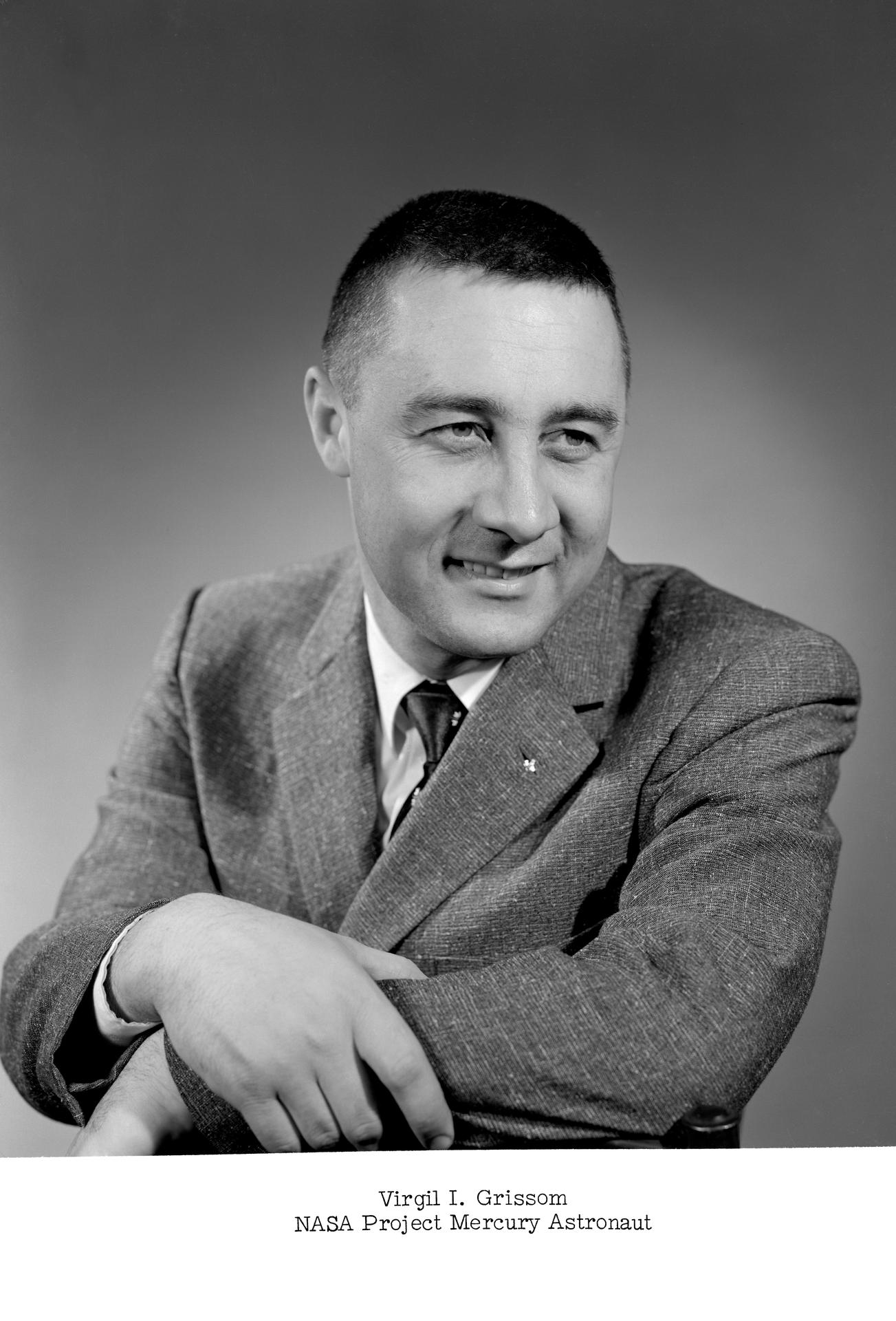
Lieutenant Colonel Virgil Ivan “Gus” Grissom had been part of the U.S. manned space program since it began in 1959, having been selected as one of NASA’s Original Seven Mercury Astronauts. His second space flight on Gemini III earned him the distinction of being the first man to fly in space twice. His hard work, drive, persistence and skills as a top notch test pilot and engineer had landed him the title of commander for the first Apollo flight. Yet for Grissom, Apollo I was to be just the beginning. He had been told privately that if all went well, he would be the first American to walk on the moon. Although Grissom already had stacked up a very impressive list of career accomplishments, being first on the moon would be the ultimate achievement for the man who grew up in a small town during the lean years of the Great Depression.
Virgil Ivan Grissom was born on April 3, 1926 in Mitchell, Indiana, a tiny Midwestern community of about three thousand residents tucked away in the southern half of the state. Virgil was the eldest of Dennis and Cecile Grissom’s four children, which included two brothers, Norman and Lowell and one sister, Wilma. Dennis Grissom managed to hold on to his job at the Baltimore and Ohio Railroad in spite of the numerous layoffs which were going on all around him. Although they were far from being wealthy, Mr. Grissom’s twenty-four dollar per week salary allowed his family to live comfortably in their white frame house in town.
Although Grissom was too short to participate in high school sports, he found a niche for himself in the local Boy Scout troop where he eventually served as leader of the Honor Guard. To earn spending money, he delivered newspapers twice a day throughout the year and, in the summer, he was hired by the local growers to pick peaches and cherries in the orchards outside of town.
Throughout high school, Virgil used a good portion of his money to take Betty Moore to the late shows at the local theater. He had first met her during his sophomore year and he immediately knew that she was the girl for him. “I met Betty Moore when she entered Mitchell High School as a freshman, and that was it, period, exclamation point! It was a quiet romance, as far as anyone could see, but a special closeness started then and has developed into something light years beyond the power of mere words to describe.”1
Grissom was, in his own words “not much of a whiz in school.”2 Without having set specific goals for himself, he simply seemed to drift through his classes. He excelled in math, but only pulled average grades in his other subjects. His high school principal remembered him as “an average solid citizen who studied just about enough to get a diploma.”3
However, World War II helped Grissom start forming some personal and career goals. He enlisted as an aviation cadet as a high school senior and reported for duty in August 1944 following graduation. He took a short leave during July 1945 to marry Betty Moore and returned to the base with high hopes of receiving flight instructions and flying combat missions. However, Japan surrendered a short time later and the war ended before he could receive his training. Grissom found himself going from one routine desk job to another. Knowing that he had joined the Air Force to fly and not to type, he decided to leave the service. His discharge came through in November 1945.
Grissom soon realized that his limited military career was going to get him nowhere. Eventually, he found a job at Carpenter’s Bus Body Works. However, he knew that he did not want to spend the rest of his life installing doors on school buses in Mitchell, Indiana. Therefore, he set another goal for himself. He would earn a bachelor’s degree in mechanical engineering from Purdue University.
While Gus attended classes during the day, Betty worked as a long distance operator. After class, Gus worked thirty hours a week flipping burgers at a local diner. Their combined incomes plus a small grant from the GI Bill financed the cost of his education and their “pint-sized apartment near the campus.”4 After three and one half years of study, Grissom graduated in 1950 with a BS in mechanical engineering. Many years later, Gus still was quick to give credit to Betty, for “she had made my degree possible.”5
After graduation, Gus made several half-hearted attempts to find employment. At one point, he considered accepting a mechanical engineering position at a brewery. However, because his heart was set on becoming a test pilot, he re-enlisted in the Air Force, finished air cadet training and won his wings.
Less than one year later, Grissom was shipped out to Korea to complete one hundred combat missions with the 334th Fighter-Interceptor Squadron. He ignored the tradition of naming a jet after one’s wife or girlfriend and chose to fly his F- 86 Sabre jet with the name “Scotty” boldly printed on it in honor of his son who had been born the year before. Another code of conduct existed on the bus ride which transported pilots from the barracks to the flight line. Pilots who personally had been shot at by a MIG were allowed to sit. Those who had not yet experienced a real piece of the action were unworthy of a seat and forced to stand. After only two missions, Gus took a seat on the bus. His first experience of being shot at came as a bit of a surprise. “I was flying along up there and it was kind of strange. For a moment I couldn’t figure out what those little red things were going by. Then I realized I was being shot at.”6 Grissom “usually flew wing position in combat, to protect the flanks of other pilots and keep an eye open for any MIGs that might be coming across.”7 He was proud to be able to say, “I never did get hit and neither did any of the leaders that I flew wing for.”8 After spending six months in Korea, Gus reached the one hundred combat missions mark. His request to fly twenty-five additional missions was denied and he was sent back to the states, having earned both the Air Medal with cluster and the Distinguished Flying Cross during his tour of duty.
The next few years brought a variety of assignments and changes for Grissom. He served as a flight instructor for new cadets, a task which Gus soon learned could be even more dangerous than the combat missions he had flown in Korea. “At least you know what a MIG is going to do. Some of these kids were pretty green and careless sometimes, and you had to think fast and act cool or they could kill both of you.”9
The family of three became a family of four when a second son, Mark arrived in 1953. In addition to his duties as an instructor, Grissom spent as much time as he could racking up extra flight hours and honing his flying skills. He “gained the reputation among his peers as one of the best jet jockies in the business.”10 Finally, after receiving additional instruction at the Institute of Technology at Wright-Patterson AFB, Grissom attended test pilot school at Edwards AFB. He received his test pilot credentials in 1957 and was transferred back to Wright-Patterson, where he specialized in testing new jet fighters. “This was what I wanted all along, and when I finished my studies and began the job of testing jet aircraft, well, there wasn’t a happier pilot in the Air Force.”11
Then, out of the blue, Grissom received an official teletype message instructing him to report to an address in Washington, D.C. wearing civilian clothes. The message was classified “Top Secret” and Grissom was not to discuss its contents with anyone. “Well, in the Air Force you get some weird orders, but you obey them, no matter what. On the appointed day, wearing my best civilian suit, and still as baffled as ever, I turned up at the Washington address I’d been given… I was convinced that somehow or other I had wandered right into the middle of a James Bond novel.”12 Nonetheless, as bizarre and surreal as the order might have seemed at the time, it would change Grissom’s life completely.
Grissom discovered that he was one of 110 military test pilots whose credentials had earned them an invitation to learn more about the space program in general and Project Mercury in particular. Gus liked the sound of the program but knew that competition for the final spots would be fierce. “I did not think my chances were very big when I saw some of the other men who were competing for the team. They were a good group, and I had a lot of respect for them. But I decided to give it the old school try and to take some of NASA’s tests.”13
Taking some of NASA’s tests turned out to be more of an ordeal than Grissom could have imagined. He was sent to the Lovelace Clinic and Wright-Patterson AFB to receive extensive physical examinations and to submit to a battery of psychological tests. Grissom was nearly disqualified when doctors discovered that he suffered from hay fever. Without missing a beat, Grissom informed them that his allergies would not be a problem because “there won’t be any ragweed pollen in space.”14 Since no one could argue that point, they passed him on to the next series of tests.
Grissom was pleased with his performance in all but one of the physical tests. “I was real disappointed in myself, and I thought that I should have done better” on the treadmill test.15 Like most of his colleagues, Grissom had an intense dislike and distrust of the psychological exams. It simply did not seem logical to him for grown men to be asked who they perceived themselves to be or what hidden figures or meanings they saw lurking in random blots of ink or blank sheets of paper. “I tried not to give the headshrinkers anything more than they were actually asking for. At least, I played it cool and tried not to talk myself into a hole. I did not have the slightest idea what they were trying to prove, but I tried to be honest with them…without getting carried away and elaborating too much.”16
The number of test pilots had dwindled steadily since the initial invitation to Washington had been issued. Finally, seven were chosen. On April 13, 1959, Air Force Captain Virgil Grissom received official word that he had been selected as one of the seven Project Mercury astronauts. Six others received the same notification:
- Lieutenant Malcolm Scott Carpenter, U.S. Navy
- Captain LeRoy Gordon Cooper, Jr., U.S. Air Force
- Lieutenant Colonel John Herschel Glenn, Jr., U.S. Marine Corps
- Lieutenant Commander Walter Marty Schirra, Jr., U.S. Navy
- Lieutenant Commander Alan Bartlett Shepard, Jr., U.S. Navy
- Captain Donald Kent Slayton, U.S. Air Force
“After I had made the grade, I would lie in bed once in a while at night and think of the capsule and the booster and ask myself, ‘Now what in hell do you want to get up on that thing for?’ I wondered about this especially when I thought about Betty and the two boys. But I knew the answer: We all like to be respected in our fields. I happened to be a career officer in the military and, I think, a deeply patriotic one. If my country decided that I was one of the better qualified people for this new mission, then I was proud and happy to help out.”17 Having made the decision to accept NASA’s invitation to join Project Mercury, Grissom moved his family to Langley AFB, Virginia and considered himself a very fortunate man to be participating in such a “weird, wonderful enterprise.”18
The next two years involved a constant round of crisscrossing the globe for flight training, planning and preparations, survival skills training, additional education, engineering work, monitoring spacecraft design and production and, of course, public relations. Sixteen hour days were not uncommon. After the first year, Grissom tallied up the number of days that he had spent away from home. He was surprised to discover that he had been gone for 305 of the past 365 days. Yet, the pressure was on to win the prize for being the first nation in space. Grissom and his colleagues knew that hard work and long hours were integral parts of the job. They kept their eyes on the prize and worked to get the job done.
However, the prize which awaited NASA’s team as a reward for all of their grueling work and training was snatched right out from under their noses on April 12, 1961. History would forever record that date as the day that Russian cosmonaut Yuri A. Gagarin became the first man in space when he completed his successful orbital flight aboard Vostok I. The space race had begun and we had been left behind, still stuck at the starting gate.
On May 5, 1961, Alan Shepard became the first American in space when he successfully piloted a suborbital flight on board the Freedom 7 spacecraft. His flight closed the gap a bit, but his fifteen minute suborbital flight could not compare with Gagarin’s one and three quarter hour orbital flight.
Gus Grissom had missed out on the opportunity to be the first American in space; he had been selected to fly the second flight. Shepard’s flight had been a very successful one. However, before the U.S. manned space program could move on to orbital flights, it was up to Grissom to prove that Shepard’s successful suborbital flight had not been just a fluke.
Grissom named his MR-4 spacecraft Liberty Bell 7. It seemed a logical choice “because the capsule does resemble a bell.”19 It had three significant improvements over Shepard’s spacecraft. The control panel had been redesigned to accommodate future orbital flights. A large picture window replaced the small portholes used in MR-3. This allowed the pilot to enjoy a better view but more importantly, it offered an improved capability for visual orientation of the spacecraft. Finally, Liberty Bell 7 was the first Mercury spacecraft to include a newly designed explosive hatch. Although the hatch had not been tested previously, it was considered to be superior in design to the older model used on Shepard’s capsule. The explosive hatch was held in place by seventy bolts and was opened by triggering a Mild Detonating Fuse, or MDF. By delivering a five pound blow to a special plunger, the pilot could activate the MDF which would blow the hatch completely off of the spacecraft, enabling the pilot to make a quicker and easier egress from the capsule.
After two postponements because of poor weather, Grissom’s Liberty Bell 7 finally was given the go ahead for launch on July 21, 1961. Grissom patiently waited out two holds during the countdown while strapped into his couch inside the spacecraft. The first hold was called so that a misaligned explosive bolt on the capsule’s hatch could be replaced. The second hold became necessary when cloud cover blocked the tracking cameras.
Gus reported a very smooth liftoff. The new picture window offered a panoramic view, and Grissom was mesmerized by the contrasting blackness of the sky with “the blue of the water, the white of the beaches and the brown of the land.”20 The only difficulty Grissom experienced during the actual flight was with the attitude controls, which he described as “sticky and sluggish.”21 G forces reached a peak of 11.2 during the re-entry period but were not a major problem for Grissom, who had handled up to sixteen G’s during training. The successful flight ended approximately fifteen minutes after lift-off when Liberty Bell 7 popped its chutes and landed safely in the Atlantic Ocean.
After splashdown, Grissom began final preparations for egress. “I opened up the faceplate on my helmet, disconnected the oxygen hose from the helmet, unfastened the helmet from my suit, released the chest strap, the lap belt, the shoulder harness, knee straps and medical sensors. And I rolled up the neck dam of my suit.”22 Grissom then turned his attention to preparing the hatch for egress by completing standard procedures for arming the detonator. He notified the recovery helicopter, code named “Hunt Club,” that he would need a few more minutes to mark all of the switch positions on the capsule’s instrument panel. Grissom’s final transmission was to the helicopter. “As soon as I had finished looking things over, I told Hunt Club that I was ready. According to the plan, the pilot was to inform me as soon as he had lifted me up a bit so that the capsule would not ship water when the hatch blew. Then I would remove my helmet, blow the hatch and get out.”23 Grissom was lying in his couch, waiting to receive final confirmation that it was time for him to blow the hatch and exit the spacecraft “when suddenly, the hatch blew off with a dull thud.”24 Water flooded the cabin. Grissom automatically threw off his helmet, grabbed the sill of the hatch, hauled himself out of the sinking capsule and swam furiously to get away from the spacecraft. The capsule had been equipped with a special dye marker package which would spew out its bright green contents in order to help recovery vehicles locate the spacecraft once it splashed down. The package was attached to the capsule by a set of lines. Once he was in the water, Grissom got tangled up in those lines and thus remained attached to the sinking spacecraft. He finally managed to extricate himself and swam away from the capsule. When the recovery chopper finally hooked on to the spacecraft, Grissom figured that both he and Liberty Bell 7 were home free.
The helicopter made a valiant effort to recover the spacecraft but with the added weight of the water which had flooded it, the capsule proved to be too heavy a load. Red warning lights flashed on the control panel, signifying that the extra weight was putting too much strain on the chopper and that an engine failure was imminent. The recovery team had no choice but to cut the spacecraft loose. Grissom watched helplessly as Liberty Bell sank from sight.
By now, Gus realized that he was having a hard time just keeping his head above the water. “Then it dawned on me that in the rush to get out before I sank I had not closed the air inlet port in the belly of my suit, where the oxygen tube fits into the capsule. Although this hole was not letting much water in, it was letting air seep out, and I needed that air to help me stay afloat.”25 With his suit quickly losing buoyancy, Grissom wished that he could dump the souvenirs he had stored in the left leg pocket of his space suit. “I had brought along two rolls of fifty dimes each for the children of friends, three one dollar bills, some small models of the capsule and two sets of pilot’s wings. These were all adding weight that I could have done without.”26
Unaware of the difficulty Grissom was having in staying afloat, none of the helicopters surrounding him were dropping him a life line. Their rotor blades were churning up the surface of the water, making it necessary for Grissom to swim even harder to keep from going under. He took a salty swill of the Atlantic with every wave that washed over his head. As exhaustion set in, he thought, “Well, you’ve gone through the whole flight, and now you’re going to sink right here in front of all these people.”27 Fear gave way to anger as he tried once again to wave for help, but no one seemed to respond. Finally, a third helicopter approached and dropped Grissom a horse collar. He managed to loop it over his neck and arms, albeit backwards, and was hoisted up. Grissom was so exhausted that he could not even remember that the chopper had to drag him fifteen feet across the water before he finally started going up. As soon as he was safely inside the helicopter, he grabbed the nearest life jacket and made sure that it was buckled on securely. After the ordeal he just had experienced, Grissom simply wanted to be certain that if the recovery helicopter went down and he went for another swim in the choppy waters of the Atlantic, he would be well prepared for the dunk.
Once he was on board the carrier, Grissom received a telephone call from President Kennedy. The President expressed relief that Gus was safe, but his words offered little consolation to the pilot who had flown a perfect flight but came back without his spacecraft. “It was especially hard for me, as a professional pilot. In all of my years of flying—including combat in Korea—this was the first time that my aircraft and I had not come back together. In my entire career as a pilot, Liberty Bell was the first thing I had ever lost.”28
After the flight, Grissom participated in a conventional debriefing during which he recounted the details of the flight. Grissom met his family upon returning to Patrick AFB. He was welcomed by NASA officials and held a press conference with reporters. Gus was never comfortable speaking with the press. In fact, he went to great lengths to avoid them whenever possible. On one occasion, he went so far as to disguise himself in a floppy straw hat and dark glasses in order to slip by reporters. Some members of the press crew responded by tagging him with the titles “Gloomy Gus” and “The Great Stone Face.” The press conference turned out to be an uncomfortable experience because “the reporters skipped over the successful aspects of the flight… and probed around the question of whether Grissom had contributed to the loss of the Liberty Bell by accidentally bumping the plunger which blew the hatch.”29 Grissom repeated his account. “I was just laying there minding my own business when, POW, the hatch went. And I looked up and saw nothing but blue sky and water starting to come in over the sill.”30 The second question which Grissom had to field dealt with whether or not he had felt that his life was in danger at any time. Characteristically, his response was honest and to the point. “Well, I was scared a good portion of the time. I guess this is a pretty good indication.”31 His reply made good sense. It also made good headlines and within no time, newspapers and magazines across the country shouted out variations on the same basic theme: “Astronaut Admits He Was Scared!” The press conference finally drew to a close and James Webb presented Grissom with NASA’s Distinguished Service Medal.
Although a review board determined that Gus did not contribute in any way to the premature detonation of the hatch, questions surrounding the incident simply would not go away. “Engineers spoke of a transient malfunction but were helpless to identify it because the capsule and the hatch were now on the bottom of the ocean.”32 Grissom was frustrated by the lack of a technical explanation. “We tried for weeks afterwards to find out what had happened and how it had happened. I even crawled into capsules and tried to duplicate all of my movements, to see if I could make the whole thing happen again. It was impossible. The plunger that detonates the bolts is so far out of the way that I would have had to reach for it on purpose to hit it, and this I did not do. Even when I thrashed about with my elbows, I could not bump against it accidentally.”33
Grissom did not like the idea of being unable to come up with a concrete reason for the hatch blowing prematurely. Yet, he was not going to waste precious time worrying about it. “It remained a mystery how that hatch blew. And I am afraid it always will. It was just one of those things.”34 The important thing was that he had flown a successful flight which corroborated Alan Shepard’s experiences and the program could move ahead.
As preparations continued for the first American orbital flight, NASA announced its plan to develop an intermediate phase space program. It would feature a spacecraft that would use the Titan II as a booster and be designed to carry a two man crew. NASA officially named the program Gemini, after the constellation represented by the twin stars Castor and Pollux.
“When my Mercury flight aboard the Liberty Bell capsule was completed, I felt reasonably certain, as the program was planned, that I wouldn’t have a second space flight. By then Gemini was in the works, and I realized that if I were going to fly in space again, this was my opportunity, so I sort of drifted unobtrusively into taking more and more part in Gemini.”35
Gus liked to be in on a project from its inception and he was able to do that with Project Gemini. He combined his skills in mechanical engineering and test piloting to help produce a manned system which was designed to rely on the input of its pilots. “Gemini would not fly without a guy at the controls… It was laid out the way a pilot likes to have the thing laid out… Gus was the guy who did all that.”36
In response to NASA’s plan to build its new Manned Space Center near Houston, the Grissom family left Virginia and moved into a three bedroom home in Timber Cove, one of the new housing developments outside of Seabrook, Texas. Grissom took steps to help shield his family from the onslaught of media attention and curiosity seekers. He had a pool installed in their backyard so that they could relax and swim in privacy. Additionally, “Grissom built a house…with no windows on the side facing the street. He simply did not want people peering into his windows.”37
Grissom greatly valued being home with his family, stating that “it sure helped to spend a quiet evening with your wife and children in your own living room.”38 Betty accommodated his hectic schedule by completing major chores and errands during the week so weekends would be free for family activities. She did not wear him down by constantly grilling him about the details of his job. In turn, Gus refused to let work problems intrude on his time at home and tried to complete technical reading or paperwork after the boys were asleep. The family made what little time they had together count. They went boating and water skiing on Clear Lake. In the winter, the entire family traveled to Colorado so Gus and the boys could ski. An annual trip to the Indianapolis 500 was always a highlight and offered a chance to visit family members back in Mitchell. Gus also introduced his sons to hunting and fishing, two of his favorite hobbies. In spite of the fact that the public had thrown the Grissoms into the spotlight, Gus demanded a normal life for his family. “Betty and I run our lives as we please. We don’t care anything about fads or frills or the P.T.A. We don’t give a damn about the Joneses.”39
Once the Gemini spacecraft was completed, Alan Shepard was selected as commander for its first manned flight. Grissom was his back up. The program was progressing steadily when everything came to a screeching halt for Alan Shepard.
Shepard began to experience severe nausea, vomiting and dizzy spells. The symptoms vanished after the first episode. Shepard felt fine and saw no reason to stop working. Then the symptoms came back again… and again… and again. Shepard knew that something definitely was not right so he had the flight surgeons check him over. Much to his dismay, he wound up with a diagnosis of Meniere’s Syndrome, an inner ear disorder that caused periods of nausea, dizziness and disorientation. With symptoms like that and with no immediate cure available, it did not take long for Alan Shepard to be grounded. As a result, the commander’s seat in the first manned Gemini spacecraft would be occupied by Gus Grissom. The pilot’s seat went to Lieutenant John W. Young, a Navy test pilot with a BS in aeronautical engineering who had been part of the second group of astronauts selected in September 1962.
Grissom took his role as commander very seriously. “I was responsible for my own skin in my Mercury flight, but now that I’m going up for a second flight… I’m responsible for two. This will mean some of the decisions will come a little harder but I’ve asked for the responsibility and I’ve got it.”40
Grissom and Young, plus their backups, Wally Schirra and Tom Stafford immersed themselves in the intensive training schedule. “I had thought training for Mercury was rigorous. Once we got caught up in the Gemini training program, our Mercury training looked pretty soft.”41
Initially, Gus wanted to name his spacecraft Wapasha after a Native American tribe that had lived in Grissom’s home state of Indiana. “Then some smart joker pointed out that surer than shooting, our spacecraft would be dubbed the Wabash Cannon Ball. Well, my Dad was working for the Baltimore and Ohio Railroad, and I wasn’t too sure just how he’d take to the Wabash Cannon Ball. How would he explain that one to his pals on the B & O?”42 Wapasha got scratched off the list of prospective names and Grissom began a new search. The Broadway musical The Unsinkable Molly Brown provided him with a source of inspiration. With the loss of Liberty Bell still on his mind, Gus decided to poke fun at the whole incident. Molly Brown had been strong, reliable and most importantly, unsinkable. It was a perfect name for Liberty Bell‘s successor. However, some of Grissom’s bosses insisted that he choose a more respectable name. Gus replied, “How about the Titanic?”43 It was clear that Grissom was not going to back down on this one. Given a choice of Molly Brown or Titanic, disgruntled officials backed off. Without further ado, Gemini-Titan 3 became known as Molly Brown.
On March 23, 1965, Molly Brown successfully lifted off from Pad 19 with Grissom and Young at the controls. Gus carried with him two specially engraved watches for Scott and Mark. Betty’s souvenir, a new diamond ring, hung safe and sound on a string around Gus’ neck.
The main objectives for the five hour flight were to test all of the major operating systems and to determine if controlled maneuvering of the spacecraft was possible. Being able to change orbit and flight path was crucial to upcoming rendezvous missions, so a lot was riding on Molly’s performance. She did not let her crew down. “To our intense satisfaction we were able to carry out these maneuvers almost exactly as planned…The longer we flew, the more jubilant we felt. We had a really fine spacecraft, one we could be proud of in every respect.”44
Scientific experiments were also part of the flight plan and Grissom had to perform one of them. “It was pathetically simple. All I had to do was turn a knob, which would activate a mechanism, which would fertilize some sea urchin eggs to test the effects of weightlessness on living cells. Maybe… I had too much adrenaline pumping, but I twisted that handle so hard I broke it off.”45 Ironically, at the same time as Gus was performing his test, a ground controller was conducting an identical experiment on earth. The controller broke off his handle as well.
Another experiment that needed to be completed was testing the new array of specially packaged space food. Because future Gemini missions were scheduled to last several days, supplying the crew with an adequate diet was critical. John Young had been assigned to conduct this important experiment . Grissom constantly complained about the dehydrated delicacies concocted by NASA nutritionists. He was willing to eat the reconstituted food only because there was nothing else available. Or so he thought. Gus had no idea that John Young had more than just souvenirs stowed in his space suit pockets.
“I was concentrating on our spacecraft’s performance, when suddenly John asked me, ‘You care for a corned beef sandwich, skipper?’ If I could have fallen out of my couch, I would have. Sure enough, he was holding an honest-to-john corned beef sandwich.”46 John had managed to sneak the deli sandwich, which was one of Grissom’s favorites into his pocket. As Gus sampled the treat, tiny bits of rye bread began floating around the pristine cabin and the crew was just about knocked over by the pungent aroma of corned beef wafting through the small confines of the spacecraft. “After the flight our superiors at NASA let us know in no uncertain terms that non-man-rated corned beef sandwiches were out for future space missions. But John’s deadpan offer of this strictly non-regulation goodie remains one of the highlights of our flight for me.”47
Molly Brown splashed down at 2:15 PM after flying eighty thousand miles and completing three successful orbits around the earth. Grissom and Young were ecstatic about their textbook flight. “I do know that if NASA had asked John and me to take Molly Brown back into space the day after splashdown, we would have done it with pleasure. She flew like a queen, did our unsinkable Molly, and we were absolutely sure that her sister craft would perform as well.”48
The flight was followed by an enthusiastic reception and parade at Cape Kennedy. The following day Grissom and Young, accompanied by their families, flew to Washington. President Lyndon Johnson awarded both men NASA’s Distinguished Service Medal. “For me, personally, the finest award I received was the opportunity for my wife and two sons to meet and shake hands with the President of the United States and Mrs. Johnson and with Vice President Humphrey. It was, I know, a moment that Scott and Mark Grissom will remember for the rest of their lives.”49 Ticker-tape parades in New York and other cities followed. “After all the Russian space spectaculars, the United States was back in the manned space flight business with probably the most sophisticated spacecraft in the world, or out of it. Our reception was the public’s way of expressing pride in a national achievement.”50
Molly Brown‘s flight was followed by nine other manned missions. Each flight gave the program a wealth of knowledge, techniques and much-needed confidence. With each successful mission, we advanced closer to the moon.
Grissom remained directly involved with the Gemini program for quite some time, including several months of training as backup commander for the Gemini 6 mission. At the same time, work on the Apollo spacecraft was already well in progress. In March 1966, NASA publicly announced that Gus Grissom had been assigned as commander for the first Apollo Earth-orbit mission. Ed White would serve as Senior Pilot and Roger Chaffee was named Pilot. Jim McDivitt, David Scott and Russell Schweickart were assigned as backups. By the time Gus was freed up from his duties on Project Gemini to jump on board the Apollo program, the spacecraft and its systems were well advanced in terms of production and testing. Unlike Gemini, Grissom and his crew inherited a spacecraft that had been designed for them, but not with them.
Although they did not have a hand in the basic design process, Grissom and his crew were able to exert some influence on Spacecraft 012, which was scheduled for an October 1966 launch. “He and Ed White and Roger Chaffee, along with their supporting staff of engineers and technicians, participated directly in the progressive design and manufacturing reviews and inspections as Spacecraft 012 neared completion. Some of the things Gus saw he did not like.”51
As the pressure mounted and dissatisfaction grew, Grissom, for the first time, began to bring his work problems home. “When he was home he normally did not want to be with the space program. He would rather be just messing around with the kids. But now he was uptight about it.”52
The arrival of Spacecraft 012 to the Cape only brought more problems. It soon became obvious that many designated engineering changes were incomplete. The environmental control unit leaked like a sieve and needed to be removed from the module. As a result, the launch schedule was delayed by several weeks. The Apollo simulator which was used for training purposes had its own set of problems and was not in any better shape than the actual spacecraft itself. According to Astronaut Walter Cunningham, “We knew that the spacecraft was, you know, in poor shape relative to what it ought to be. We felt like we could fly it, but let’s face it, it just wasn’t as good as it should have been for the job of flying the first manned Apollo mission.”53 Nonetheless, the crew made do with what they had and by mid January of 1967, preparations were being made for the final preflight tests of Spacecraft 012.
On January 22, 1967, Grissom made a brief stop at home before returning to the Cape. A citrus tree grew in their backyard with lemons on it as big as grapefruits. Gus yanked the largest lemon he could find off of the tree. Betty had no idea what he was up to and asked what he planned to do with the lemon. ” ‘I’m going to hang it on that spacecraft,’ Gus said grimly and kissed her goodbye.”54 Betty knew that Gus would be unable to return home before the crew conducted the plugs out test on January 27, 1967. What she did not know was that January 22 would be “the last time he was here at the house.”55
Additional information about Grissom, including his official NASA biography.
Notes
- Virgil Grissom. Gemini: A Personal Account of Man’s Venture Into Space (New York: The Macmillan Company, 1968), p. 18.
- Ibid., p. 17.
- Betty Grissom and Henry Still. Starfall (New York: Thomas Y. Crowell Company, 1974), p. 24.
- Grissom, p. 18.
- Ibid., p. 19.
- Grissom and Still, p. 38.
- M. Scott Carpenter, et al., We Seven (New York: Simon and Schuster, 1962), p. 55.
- Ibid., p. 56.
- Ibid.
- Grissom and Still, p. 42.
- Grissom, pp. 19, 21.
- Ibid., pp. 21–22.
- Carpenter, et al., p. 57.
- Grissom and Still, p. 56.
- Carpenter, et al., p. 57.
- Ibid.
- Ibid., p. 58
- Grissom, p. x.
- Carpenter, et al., p. 214.
- Ibid., p. 221.
- Ibid., p. 222.
- Ibid., p. 224.
- Ibid., p. 225.
- Ibid.
- Ibid., p. 226.
- Ibid.
- Ibid.
- Ibid., p. 227.
- Grissom and Still, p. 106.
- Turner Home Entertainment. Moon Shot (Atlanta: Turner Broadcasting System, Inc., 1994).
- Ibid.
- Grissom and Still, p. 106.
- Carpenter, et al., p. 227.
- Ibid.
- Grissom, p. 73.
- Donald Slayton with Michael Cassutt. Deke!—U.S. Manned Space: From Mercury to the Shuttle (New York: Tom Doherty Associates, Inc., 1994), p. 185.
- Henry Dethloff. Suddenly Tomorrow Came… A History of the Johnson Space Center (Houston: Lyndon B. Johnson Space Center, National Aeronautics and Space Administration, 1993), p. 124.
- Grissom, p. 84.
- Editors, Life magazine. Project Mercury (New York: Simon and Schuster, 1964), p. 29.
- Grissom and Still, p. 144.
- Grissom, p. 73.
- Ibid., p. 94.
- Ibid.
- Ibid., p. 112.
- Ibid., p. 110.
- Ibid.
- Ibid., p. 111.
- Ibid., p. 116.
- Ibid., p. 115.
- Ibid., pp. 115–116.
- Grissom and Still, p. 179.
- Ibid.
- Turner Home Entertainment, Moon Shot.
- Grissom and Still, p. 182.
- Ibid.
by Tara Gray
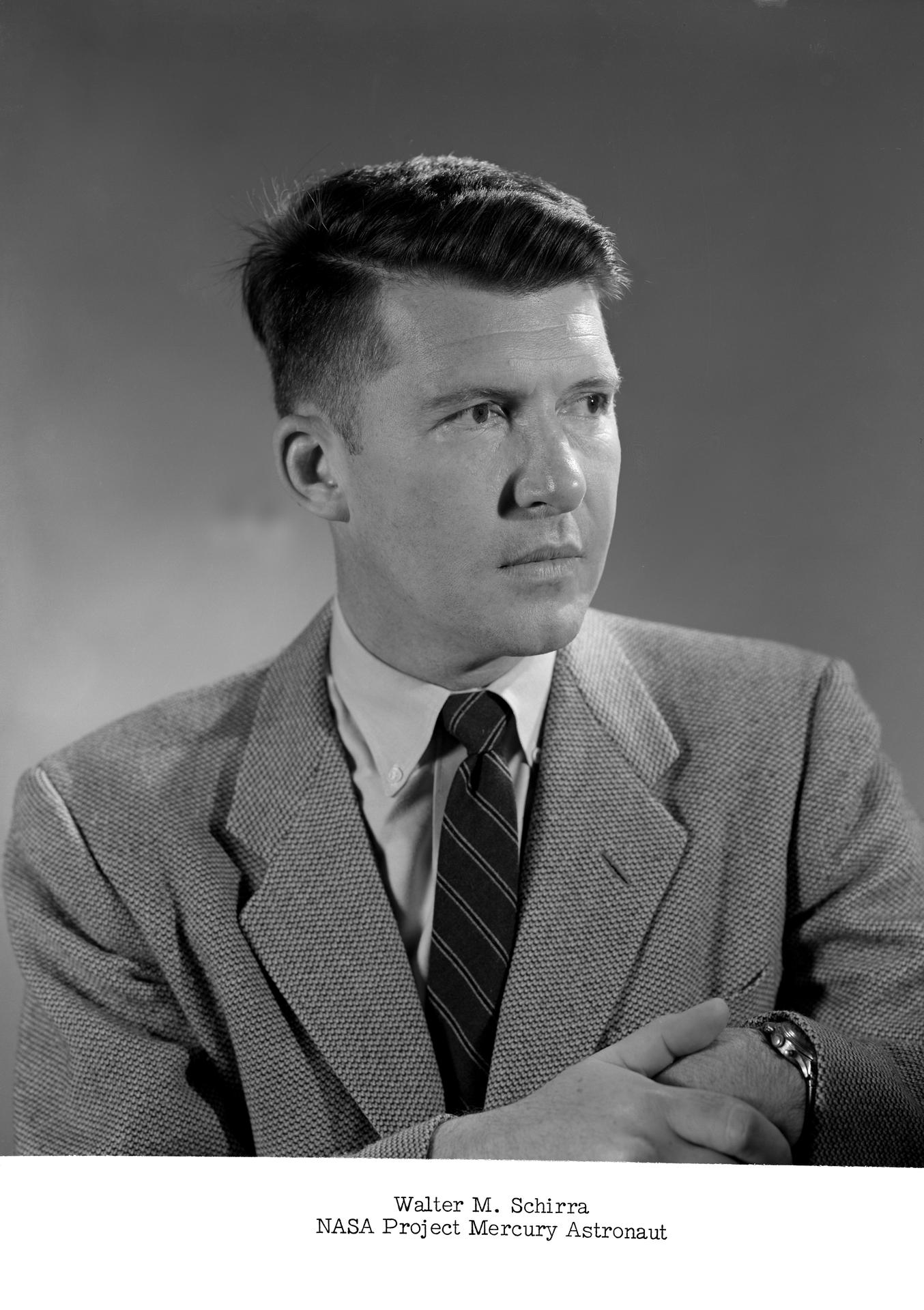
Walter Marty Schirra, Jr. (Captain, USN, Ret.), was born on March 12, 1923, in Hackensack, New Jersey, to parents Walter Marty Sr. and Florence Shillito (Leach) Schirra. His father, an engineering graduate of Columbia University with Royal Canadian Air Force Flight training, was commissioned a first lieutenant in the Army Signal Corps. He flew bombing and reconnaissance missions over Germany during World War I, and after the war he barnstormed at county fairs around New Jersey as a stunt flier with his wife, who sometimes stood on the wing of his biplane.1 Schirra is married to the former Josephine Cook “Jo” Fraser of Seattle, Washington, the step-daughter of Admiral James L. Holloway (USN, Ret.) who was Commander-in-Chief of the Northeastern Atlantic and Mediterranean area.2
Schirra graduated from Dwight W. Morrow High School in Englewood, New Jersey, in June 1940. He studied aeronautical engineering at the Newark College of Engineering (now the New Jersey Institute of Technology) from 1940 to 1942. In 1942, he was appointed to the United States Naval Academy and received a Bachelor of Science degree on June 6, 1945. Upon graduation he was commissioned in the Navy as an ensign and assigned to the armored battle cruiser Alaska, which was bound for Japan, but the war had ended by the time he arrived. On February 23, 1946, he was married and later that year he was assigned to the staff of the 7th Fleet in the Pacific in China, and in 1948, after completing pilot’s training at Pensacola Naval Air Station, Florida, he was designated a naval aviator and assigned to Fighter Squadron 71. As an exchange pilot with the 154th Fighter Bomber Squadron during the Korean War, he flew 90 combat missions in F-84E jets—mainly low-level bombing and ground-strafing operations. He was credited with downing at least one MiG fighter and possibly a second one.3
From 1952 to 1954, Schirra served as a test pilot at the Naval Ordnance Training Station at China Lake, California, where he took part in the development of the Sidewinder air-to-air missile.4 During one test flight, after he had launched the Sidewinder from his jet, the missile doubled back in the direction of his plane and Schirra had to use great skill to evade it.5 From 1954 to 1956, he was a project pilot for the F7U-3 Cutlass jet fighter and instructor pilot on the Cutlass and the FJ-3 Fury. In 1956 and 1957, he flew F3H-2N Demons as Operations Officer of Fighter Squadron 124 onboard the aircraft carrier Lexington in the Pacific.6 In 1957 he attended the Naval Air Safety Officer School at the University of Southern California, and in 1958 and 1959 he completed test pilot’s training at the Naval Air Test Center at Patuxent River, Maryland, and was assigned to suitability development work on the F-4h jet fighter there.7
Schirra was working at Patuxent River when he first heard about the Mercury Project. He stated that at first he was not keenly interested in being an astronaut, but the more he heard about the idea, the more interested he got.8 As the doctors at the Lovelace Clinic in Albuquerque, New Mexico, were testing him for a position as an astronaut in the Mercury Project they discovered a polyp on his larynx. The doctors at the Clinic offered to remove it for him then, however the treatment included absolute silence for four days. This was impossible at the time because he was due in Dayton, Ohio, to take some psychological tests which would require Schirra to speak. He was also still in the Navy, which meant that he had to consult with his commanding officers before anything like that could be done. Later on the medics put him on a week’s silent treatment. He broke it only once when a NASA official called from Langley to ask how his polyp was coming along. At the end of the week the doctors decided to go ahead and operate immediately. They arranged to give him what was normally a two or three month treatment in two to three days in order to get it over with. This was Schirra’s first clue that he was on the way to becoming one of NASA’s first seven astronauts.9
Schirra was named as one of the “Original Seven” Mercury Astronauts on April 9, 1959. NASA announced that the seven men, Alan B. Shepard, Jr., Virgil I. “Gus” Grissom, John H. Glenn, Jr., M. Scott Carpenter, Schirra, L. Gordon Cooper, Jr., and Donald K. “Deke” Slayton, had been selected from among 110 of the nation’s top military test pilots to train as astronauts for Project Mercury, the first phase of the U.S. space program, involving one-man suborbital and orbital missions. Schirra, Shepard and Carpenter were from the Navy; Grissom, Cooper, and Slayton were from the Air Force; and Glenn was from the Marine Corps.10
Schirra’s special responsibility in Project Mercury was the development of environmental controls or life-support systems that would ensure the safety and comfort of the astronaut within the spacecraft during the mission. His tasks also included the testing and improvement of the pressurized suit worn by the astronauts.11
On May 24, 1962, he served as backup pilot for MA-7, the three orbit mission flown by Carpenter. On June 27, 1962, Schirra was designated for America’s fifth manned space mission and third orbital flight, originally scheduled for September 28, 1962. A malfunctioning fuel-control valve delayed the flight of MA-8 until October 3, 1962. Schirra piloted the capsule Sigma 7 on a six-orbit mission lasting 9 hours, 13 minutes, and 11 seconds. The capsule attained a velocity of 17,557 miles per hour and an altitude of 175 statute miles, the capsule traveled almost 144,000 statute miles before reentry into Earth’s atmosphere.12 He proved that an astronaut could carefully manage the limited amounts of electricity and maneuvering fuel necessary for longer, more complex flights. He chose the name Sigma because it symbolized engineering precision, and the result was precisely engineered flight that many have termed a “textbook spaceflight.” The capsule splashed down only 4.5 miles from the aircraft carrier Kearsarge in the Pacific Ocean13 about 275 miles northeast of Midway Island.14 He was later awarded with the NAS Distinguished Service Medal for his work in the Mercury Project.15
After Project Mercury, Schirra worked with the other astronauts and with NASA officials, scientists and engineers in the development of Project Gemini, the intermediate stage between the Mercury program and the Apollo Moon project. He served as the backup command pilot for Gemini GT-3 (Gemini-Titan), the first American two-man space mission flown by Grissom and John W. Young, an astronaut chosen with the second astronaut class dubbed the “New Nine.” On June 22, 1965, Schirra was nominated by President Lyndon B. Johnson for promotion from commander to captain.16
Schirra’s second spaceflight began on December 15, 1965, when he was launched as the command pilot aboard Gemini GT-6A. The mission was intended to perform the first rendezvous and docking between different spacecraft, a vital prerequisite for missions to the moon, but the unmanned Agena target for Gemini 6 failed to reach orbit on October 25, 1965. Gemini 6 was removed from the pad and replaced by Gemini 7, which was launched on December 4, 1965, on a planned 14-day flight. Gemini 6 was redesignated Gemini 6-A.17
Eight days later, Schirra and pilot Thomas P. Stafford were in their spacecraft atop the Titan II booster when it ignited, then shut down after only two seconds. Rather than eject himself and Stafford, Schirra chose to remain in the spacecraft while technicians confirmed that the booster was not going to explode.18 On December 15, 1965, Schirra and Stafford finally launched and less than six hours later they were completing a non-docking orbital rendezvous with astronauts Frank Borman and James A. Lovell, Jr., both from the “New Nine,” aboard Gemini 7, 170 miles above the Mariana Islands. Gemini GT-6A splashed down on December 1 in the Atlantic Ocean, just eight miles from the USS Wasp19 after 16 orbits over 25 hours 51 minutes and 24 seconds.20
On September 29, 1966, Schirra was assigned to the prime crew for the second manned Apollo flight. He served as the backup commander for Apollo 1 (204), scheduled for launch on February 21, 197. During a routine “plugs out test” on January 27, 1967, the crew, Grissom; Ed White, first American to perform an EVA (extravehicular activity); and rookie astronaut Roger Chaffee; was killed in a fire in the spacecraft while on the pad. On May 9, 1967, Schirra was reassigned to the prime crew for the first manned Apollo flight. That assignment was confirmed later that year on November 20.21

Schirra’s third and final mission began on October 11, 1968, when he was launched as commander of Apollo 7, the first manned Apollo mission, making him the only Mercury astronaut to fly aboard Mercury, Gemini, and Apollo spacecrafts. During the flight, astronauts Schirra, Donn Eisele, Command/Service Module (CSM) Pilot, and Walter Cunningham, Lunar Excursion Module (LEM) Pilot, tested the spacecraft’s systems, in particular the systems that had been redesigned after the Apollo 1 fire. They performed rendezvous exercises with the upper stage of the Saturn 1-B launch vehicle and provided the first television pictures from a U.S. spacecraft. All three astronauts developed head colds during their almost 11 days in space.22 Approximately 15 hours into the flight Schirra developed a bad cold, and Cunningham and Eisele soon followed suit. In the weightlessness of space, mucus accumulates , filing the nasal passages and does not drain from the head. The only relief is to blow hard, which is painful to the eardrums. Several days before the mission ended, they began to worry about wearing their suit helmets during reentry, which would prevent them from blowing their noses. The buildup of pressure might burst their eardrums. Mission Control tried to persuade them to wear the helmets, anyway, but Schirra was adamant. They each took a decongestant, Actifed, an hour before reentry and made it through the acceleration zone without any problems with their ears.23 After 163 orbits over 10 days and 20 hours, they landed on October 22, 1968, in the Atlantic Ocean and were recovered by the USS Essex.24
Schirra retired from the Navy as a captain and resigned from NASA on July 1, 1969, to become president of Regency Investors Incorporated, a major financial complex and worldwide leasing company based in Denver, Colorado. From 1970 to 1973, he was chairman and chief executive officer of Environmental Control Company (ECCO), based in Englewood, Colorado. From 1973 to 1974, he was chairman of the board of SERNCO Incorporated, and for the next three years he was a director at Johns-Manville Corporation in Denver, Colorado. From 1978 to 1979, he was vice president for development at Goodwin Companies Incorporated in Littleton, Colorado.25
In January 1979 he formed his own firm, Schirra Enterprises, and he worked as an independent consultant in 1979 and 1980. In 1980, he was elected to the board of directors of Electromedics Incorporated. He has also served as president of Prometheus, an energy development company in Colorado, and on the board of directors of Kimberly Clark, Finalco and Net Air International.26 In 1984, he and the other surviving Mercury astronauts and Gus Grissom’s widow, Betty Grissom, founded the Mercury Seven Foundation to raise money for scholarships for science and engineering students in college. In 1995, the organization was renamed the Astronaut Scholarship Foundation.27 Schirra is currently a private consultant in Rancho Santa Fe, California, a public speaker and a television commercial spokesman for Actifed, the cold remedy he took on Apollo 7.28
Schirra received numerous honors and awards while in the service of the United States Navy and NASA including; honorary Doctorate of Astronautical Engineering from Lafayette College; honorary Doctorate of Astronautics from the Newark College of Engineering; and an honorary Doctorate of Science from the University of Southern California. He is a fellow in the American Astronautical Society and the Society of Experimental Test Pilots; a member of the American Institute of Aeronautics and Astronautics and American Fighter Pilots Association; a 33rd Degree Mason; director of the Rocky Mountain Airways; on the Department of the Interior Advisory Board on National Parks, Historical Sites and Monuments; a member of the Honorary Belgian Consul of Colorado; and director of Electromedics, Colorado, and Watt County, Nashville, Tennessee.29
He has received three Distinguished Flying Crosses; two Air Medals; two NASA Distinguished Service Medals, two NASA Exceptional Service Medals; the Navy Distinguished Service Medal; Navy Astronaut Wings; the National Aeronautic Association (NAA) Robert J. Collier Trophy in 1963; Newark College of Engineering Alumnus Award; Society of Experimental Test Pilots (SETP) Iven C. Kincheloe Award; American Institute of Aeronautics and Astronautics (AIAA) Award in 1963; American Astronautical Society (AAS) Flight Achievement Award in 1966; Kitty Hawk Award; Great American Award; Golden Key Award; American Rocket Society (ARS) Astronautics Award in 1963; and Harmon International Aviation Trophy for 1966. He was inducted into the National Aviation Hall of Fame in Dayton, Ohio, on July 26, 1986.30
Schirra has brown hair and brown eyes, stands 5 feet 10 inches tall and weighs 185 pounds. He and his wife, Jo, have two children: Walter Marty III, born on June 23, 1950, and Suzanne Karen, born on September 29, 1957.31
Additional information about Schirra, including his official NASA biography.
Notes
- Hawthorne, Douglas B. Men and Women of Space (San Diego: Univelt Incorporated, 1992), p. 623.
- “Walter Marty Schirra, Jr.” National Aeronautics and Space Administration (Washington, DC: May 1961). Hereafter referred to as NASA Biography.
- Hawthorne, pp. 623–624.
- NASA Biography.
- Hawthorne, p. 624.
- NASA Biography.
- Hawthorne, p. 624.
- Carpenter, M. Scott, et al., We Seven (New York: Simon and Schuster, 1962), pp. 76, 78, 80.
- Ibid., pp. 80–82.
- Hawthorne, p. 624.
- Ibid.
- “Walter M. Schirra, Jr.” Manned Spacecraft Center Biographical Data (Houston, Texas: June 1967), p. 2. Herafter referred to as MSC Biography.
- Hawthorne, p. 624.
- MSC Biography, p. 2.
- Ibid., p. 1.
- Hawthorne, pp. 624–625.
- Ibid., p. 625.
- “Something Was Amiss, But They Felt No Peril.” Washington Post, December 13, 1965, pp. A1, A7.
- Hawthorne, p. 625.
- Dumoulin, Jim. “Gemini-VI-A (7).” NASA Project Gemini VI-A, 1998. (August 4, 1998), p. 2.
- Hawthorne, p. 625.
- Ibid.
- Dumoulin, Jim. “Apollo-7 (23).” NASA Apollo Mission Apollo-7, 1998. (August 4, 1998), p. 4.
- Hawthorne, p. 625.
- Ibid.
- Ibid.
- “Adm. Alan Shepard, Jr. Biography.” The Hall of Science and Exploration. (July 27, 1998), p. 4.
- Hawthorne, p. 625.
- Ibid., p. 623.
- Ibid.
- Ibid.
by Tara Gray
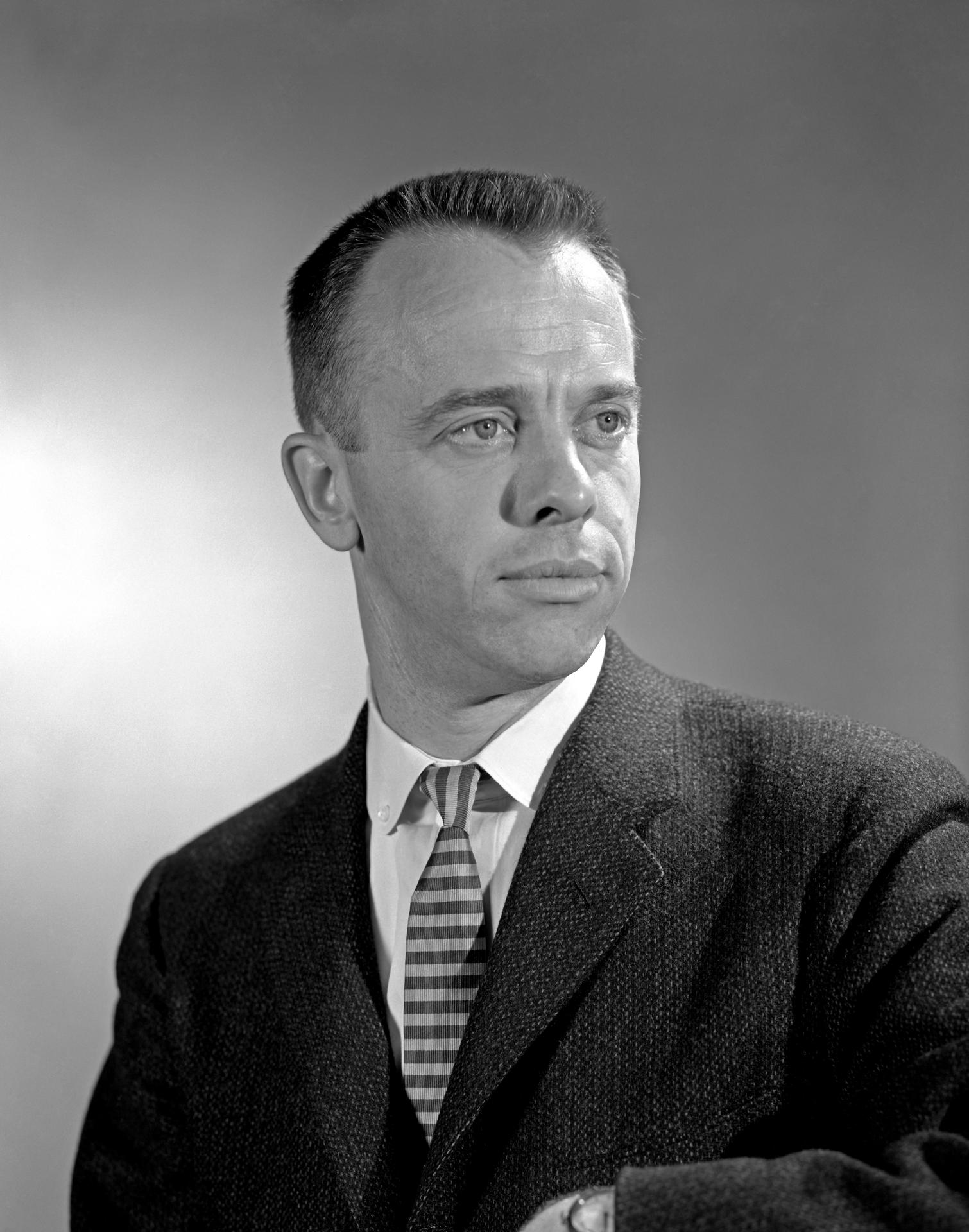
Alan B. Shepard, Jr. (RADM, USN, Ret.), was born on November 18, 1923, in East Derry, New Hampshire, to parents Lt. Col. Alan B. Shepard (USA, Ret.) and Renza (Emerson) Shepard.1 He attended primary school in East Derry and was graduated from the Pinkerton Academy in Derry, New Hampshire, in 1940.2 He studied one year at Admiral Farragut Academy, Toms River, New Jersey, and then entered the United States Naval Academy, Annapolis, Maryland. He was graduated from the Naval Academy on June 7, 1944.3 After graduation, Shepard was commissioned as an ensign and during the final year of World War II he served on the destroyer Cogswell deployed in the Pacific.4 At war’s end, on March 3, 1945, Shepard married the former Louise Brewer, of Kennett Square, Pennsylvania, whom he had met while he was a midshipman at the Naval Academy.5
After the war, he underwent naval flight training at Corpus Christi Naval Air Station, Texas, and Pensacola Naval Air Station, Florida. During training he was so eager to fly that he studied and received a pilot’s license at a civilian flying school before winning his Navy wings in March 1947.6 His next assignment was with Fighter Squadron 42 at Norfolk, Virginia, and Jacksonville, Florida. He served several tours aboard aircraft carriers in the Mediterranean while with this squadron.7 Shepard went to the United States Navy Test Pilot School at Patuxent River, Maryland, in 1950, then served two tours in flight test work at that station.8 During those tours, he took part in high altitude tests to obtain data on light at different altitudes and on a variety of air masses over the American Continent. He also participated in experiments in test and development of the Navy’s inflight refueling system, carrier suitability trials of the F2H3 Banshee, and trials of the first angled carrier deck.9 During his second tour at Patuxent, he was engaged in testing the F3H Demon, F8U Crusader, F4d Skyray, and F11F Tigercat. He was project test pilot on the F5D Skylancer and spent his last five months there as an instructor in the test pilot school.10 Between these two tours, from 1953 to 1956, he was assigned to Fighter Squadron 193 at Moffett Field, California, a night fighter unit flying Banshee jets. He was operations officer of the unit and made two trips with it to the Western Pacific aboard the Carrier Oriskany.11 After completing his second tour at Patuxent, he attended Naval War College at Newport, Rhode Island, and was subsequently assigned to the staff of the Commander-in-Chief, Atlantic Fleet, as an aircraft readiness officer.12
In 1959 the newly created National Aeronautics and Space Administration (NASA) invited 110 top test pilots to volunteer for the manned space flight program. When NASA sent out bids to 110 test pilots, asking them to volunteer, Shepard was disappointed because he did not receive an invitation. It turned out later that his name had been among the 110, but his invitation had been misplaced.13 Of the original 110, Shepard was among the seven chosen for Project Mercury and presented to the public at a press conference on April 9, 1959, held in the ballroom of the historic Dolley Madison House, NASA’s temporary headquarters on Lafayette Square.14 The other six were Virgil I. (Gus) Grissom, John H. Glenn, Jr., Donald K. (Deke) Slayton, Malcolm S. (Scott) Carpenter, Walter M. (Wally) Schirra, Jr., and L. Gordon Cooper, Jr. These seven were subjected to an unprecedented and grueling training in the sciences and in physical endurance. Every conceivable situation the men would encounter in space travel was studied and, when possible, simulated with training devices.15
Shepard quickly established himself as a first-rate pilot and engineer. When it came time to split up the technical work Shepard, with his experience with ships and Navy headquarters people, concentrated on the tracking range and the recovery teams needed to pull the astronauts and their spacecrafts out of the water after flight.16 On February 21, 1961, Robert Gilruth, the director of Project Mercury, announced that the there was to be a meeting of only the seven Mercury astronauts and himself at their headquarters at Langley. It was at this meeting that it was announced that Shepard would be the prime pilot for the first mission and Glenn would be his backup pilot. However, the actual choice was not made public until shortly before the launch for fear of having to go to the backup at the last moment. The public was informed that the choice of the first American in space had been narrowed down to Shepard, Grissom and Glenn.17 The announcement that Shepard would definitely be the first American into space came on May 2, 1961, after the first launch attempt was scrubbed due to weather.18
On May 5, 1961, only 23 days after Yuri A. Gagarin of the Soviet Union became the first man in space, Shepard was launched at 9:34am EST aboard the spacecraft he named Freedom 7 (MR-7) powered by a Redstone booster (MR-3).19 He was launched suborbitally to an altitude of over 116 miles, 303 statute miles down range from Cape Canaveral. His 15 minute 28 second flight achieved a velocity of 5,134 miles per hour and pulled a maximum of 11G’s.20 Freedom 7 splashed down in the Atlantic Ocean where the aircraft carrier Lake Champlain awaited his arrival. The capsule came through the entire flight in such excellent shape that the engineers who went over it with a fine-tooth comb decided that it could easily be used again.21 The doctors also assessed that the commander was in excellent shape, physically and psychologically and “…could be used again too.”22
Despite the fact that Gagarin’s flight had taken place three weeks earlier, Shepard’s flight was still a history-making event. Whereas Gagarin had only been a passenger in his vehicle, Shepard was able to maneuver the Freedom 7 spacecraft himself. While the Soviet mission was veiled in secrecy, Shepard’s flight, return from space, splashdown at sea and recovery by helicopter to a waiting aircraft carrier were seen on live television by millions around the world. On his return, Shepard was honored with parades in Washington, New York, and Los Angeles.23 He was awarded with the NASA Distinguished Service Medal for his Mercury flight by President John F. Kennedy in a ceremony at the White House.
After MR-3, Shepard served as capsule communicator (CAPCOM) for the flights of Grissom and Glenn, and was back up pilot to Cooper on MA-9.24 As Gordon Cooper entered the final stages of training for the Mercury-Atlas 9 flight in early 1963, discussions were taking place within NASA concerning what form the next U.S. manned spaceflight would take. Mercury Mark II, renamed Gemini, was well into the development and redesign phase of construction and it looked likely that this new two-manned spacecraft would follow Cooper’s flight. However, the first manned flights of Gemini were at that time planned for a year in the future and so a significant hiatus in U.S. manned spaceflight looked likely.25
One of the options considered by NASA officials in early 1963 was to fly another Mercury-Atlas spacecraft in order to increase U.S. manned spaceflight experience and to fill the gap before the first manned Gemini launch. This mission would have been MA-10—a planned three-day “extended duration” flight—piloted by Shepard. Shepard even went as far as naming the capsule Freedom 7 II and having the name painted onto the spacecraft just below the trapezoidal window. The astronauts were enthusiastic about the proposal to fly one more Mercury mission and even went as far as lobbying President Kennedy. Kennedy, however, was happy to leave the final decision up to NASA.26
As the launch date for MA-9 approached, it became clear that this was going to be the last flight of the Mercury program. On May 11, 1963, Julian Scheer, Deputy Assistant Administrator for Public Affairs at NASA Headquarters, announced that if MA-9 was a success there would be no MA-10. NASA Administrator James Webb announced before the U.S. Senate Space Committee on June 12, 1963, that Mercury had accomplished its goals and that priority should go to the new Gemini program. McDonnell’s Mercury spacecraft contract was terminated on June 13 and the MA-10 spacecraft was placed in storage at Cape Canaveral thereby losing its chance of ever getting into orbit.27
After the cancellation of Shepard’s second Mercury flight, he began training with Frank Borman, a member of the second group of astronauts selected by NASA, for the flight of the first manned Gemini mission. However, in early 1964 Shepard awoke one morning feeling nauseated. He met with Chief Astronaut Deke Slayton to report on what he encountered. He had become extremely dizzy, fallen and then became ill. For several days Shepard felt fine, his episode apparently behind him. Until the fifth day, when he again experienced head-spinning and vomiting.28 Once again the room whirled madly. He felt and heard an awful ringing in his left ear that went as quickly as it came. It came back several times and Shepard knew something was dangerously, terribly wrong so he checked in with the flight surgeons.29
He was diagnosed with Meniere’s syndrome, a condition in which fluid pressure builds up in the inner ear and makes the semicircular canals and motion detectors extremely sensitive. It results in disorientation, dizziness and nausea. He was also diagnosed with glaucoma, an elevated pressure in the eyeballs.
A panel of NASA medics pulled him from the flight rotation and grounded him in late 1963 and the Navy forbade him from flying jet planes solo for fear of the condition flaring while flying. However he did not leave NASA; he took over Slayton’s job as Chief of the Astronaut Office when Slayton was moved up to the new position of Chief of Flight Crew Operations.30 As Chief Astronaut, he was responsible for monitoring the coordination, scheduling and control over all activities involving the other astronauts. This included monitoring the development and implementation of programs for training spaceflight personnel, and furnishing pilot evaluations of the design, construction and operations of spacecraft systems and related equipment. He also assisted in overall mission planning and selecting experiments to be carried into space.31 Unable to take part in active astronaut training, he devoted his free time to investing his money in banks and real estate. He became so successfully well-connected with the Houston elite that he was widely accounted as the first millionaire in the astronaut corps.32
In early 1969, Shepard decided to have an operation on his ear. He went to a Los Angeles physician, checked into the hotel under a pseudonym to avoid publicity, and had a small tube planted in his inner ear. The tube was designed to drain the fluid from his ear into a spinal cavity. The operation was a success and Shepard was restored to full flight status on May 7, 1969.
Slayton named him Commander of the crew of Apollo 14 along with Edgar Mitchell, Lunar Module Pilot (LMP), and Stuart Roosa, Command Module Pilot (CMP). Shepard’s second and final spaceflight began with the launch of the Saturn V rocket from the Cape on January 31, 1971. Shepard and Mitchell landed the lunar module Antares on February 5 in the Fra Mauro highlands while Roosa orbited overhead in the command module Kitty Hawk.33 Shepard planted his feet on the lunar surface a few hours later, declaring, “Al is on the surface, and it’s been a long way, but we’re here.”34 The astronauts used a two-wheeled trolley, dubbed “Shepard’s Rickshaw” to carry cameras and geological tools and collected 94 pounds of lunar samples, including two rocks weighing 10 pounds each.35
Near the end of the second lunar extravehicular activity (EVA) and just before entering the lunar module for the last time, Shepard—an avid golfer—hit two golfballs with a makeshift club. The first landed in a nearby crater. The second was hit squarely, and in the one-sixth gravity of the Moon, Shepard said it traveled “miles and miles and miles.”36
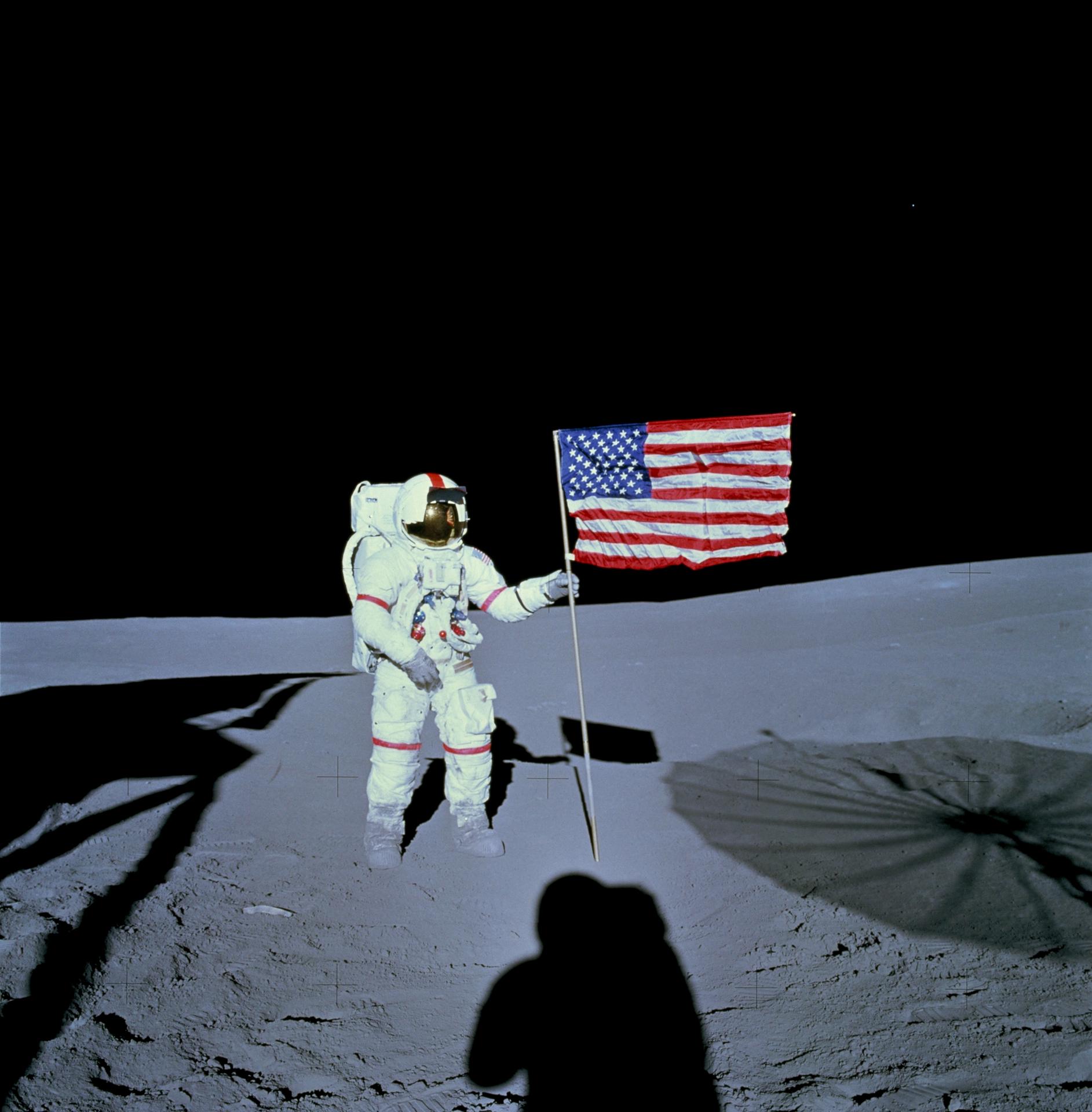
In June 1971, he resumed his duties as Chief of the Astronaut Office. He was appointed by President Richard M. Nixon the following month as a delegate to the 26th United Nations General Assembly and served in that capacity from September to December 1971. The Navy promoted him to Rear Admiral on December 1, 1971. He retired from the Navy and resigned from NASA on July 31, 1974.37 He later joined the Marathon Construction Company of Houston as partner and chairman and also served as president of the Windward Distributing Company, a Coors beer distributor in the Houston suburb of Deer Park. He later founded his own business company, Seven Fourteen Enterprises, named for his two missions on Freedom 7 and Apollo 14.38
In 1984, he and the other surviving Mercury astronauts, along with Betty Grissom, the widow of astronaut Gus Grissom, founded the Mercury Seven Foundation to raise money for scholarships for science and engineering students in college.39 In 1995, the organization was renamed the Astronaut Scholarship Foundation. Shepard was elected president and chairman of the foundation, posts he held until October 1997, when he turned over both positions to former astronaut James A. Lovell.40
Shepard attended primary and secondary schools in Derry and East Derry, New Hampshire, and he received a bachelor of Science degree from the United States Naval Academy in 1944. He was awarded an honorary Master of Arts degree from Dartmouth College in 1962, an honorary Doctorate of Science from Miami University (Oxford, Ohio) in 1971, and an honorary Doctorate of Humanities from Franklin Pierce College in 1972.41
Among the many honors Shepard received he was awarded the Congressional Medal of Honor (Space), two NASA Distinguished Service Medals, the NASA Exceptional Service Medal, the Navy Distinguished Flying Cross, the Langley Medal (highest award of the Smithsonian Institution), the Lambert Trophy, the Kinchloe Trophy, the Cabot Award, the Collier Trophy, the City of New York Gold Medal (1971), and the American Astronautical Society’s Flight Achievement Award for 1971.42
Shepard had brown hair and blue eyes. He was 5 feet 11 inches tall and weighed 170 pounds. Shepard and his wife Louise had two daughters: Julie Shepard Snyder, July 2, 1947, and Julie Shepard Coleman, March 16, 1951; they also raised a niece, Alice. They also have six grandchildren.43
Shepard died on the night of July 21, 1998, after a lengthy illness in Monterey, California. He was 74.
Additional information about Shepard, including his official NASA biography.
Notes
- Hawthorne, Douglas B. Men and Women of Space (San Diego: Univelt Incorporated, 1992), p. 662.
- “Alan Bartlett Shepard, Jr.” National Aeronautics and Space Administration (Washington, DC, May 1961).
- Hawthorne, p. 662.
- “Adm. Alan Shepard, Jr. Biography.” The Hall of Science and Exploration. http://www.achievement.org/autodoc/page/she0bio-1 (July 27, 1998), p. 1. Hereafter referred to as Hall of Science and Exploration.
- Hawthorne, p. 662.
- Ibid., p. 663.
- “Alan B. Shepard, Jr.” Johnson Space Center Biography. http://www.jsc.nasa.gov/Bios/htmlbios/shepard-alan.html (July 27, 1998), p. 1. Hereafter referred to as JSC Biography.
- “Alan B. Shepard, Jr.” Manned Spacecraft Center Biographical Data. Houston, Texas. January 1965, p. 1.
- Ibid.
- Ibid.
- Ibid., p. 2.
- Ibid.
- Hawthorne, p. 663.
- Shepard, Alan B., Jr., and Deke Slayton. Moon Shot: The Inside Story of America’s Race to the Moon (Atlanta: Turner Publishing, 1994), p. 61.
- Hall of Science and Exploration, p. 2.
- Carpenter, M. Scott, et al. We Seven (New York: Simon and Schuster, 1962), p. 98.
- Ibid., pp. 229–230.
- Ibid., p. 238.
- Dumoulin, Jim. “MR-3 (18).” NASA Project Mercury Mission MR-3, 1997. http://www.ksc.nasa.gov/history/mercury/mr-3/mr-3.html (July 27, 1998), p. 1.
- Ibid., p. 2.
- Carpenter, et al., p. 263.
- Ibid.
- Hall of Science and Exploration, p. 2.
- Hawthorne, p. 663.
- Wilson, Keith T. “Mercury Atlas 10: A Mission Not Flown.” Quest (Winter 1993): 23–25
- Ibid., p. 24.
- Ibid.
- Shepard, p. 168.
- Ibid., p. 168.
- Ibid., p. 169.
- Hawthorne, p. 664.
- Ibid.
- Ibid.
- Hall of Science and Exploration, p. 3.
- Hawthorne, p. 664.
- Hall of Science and Exploration, p. 3.
- Hawthorne, p. 664.
- Hall of Science and Exploration, p. 4.
- Ibid.
- Ibid.
- JSC Biography, p. 1.
- Ibid.
- Ibid.
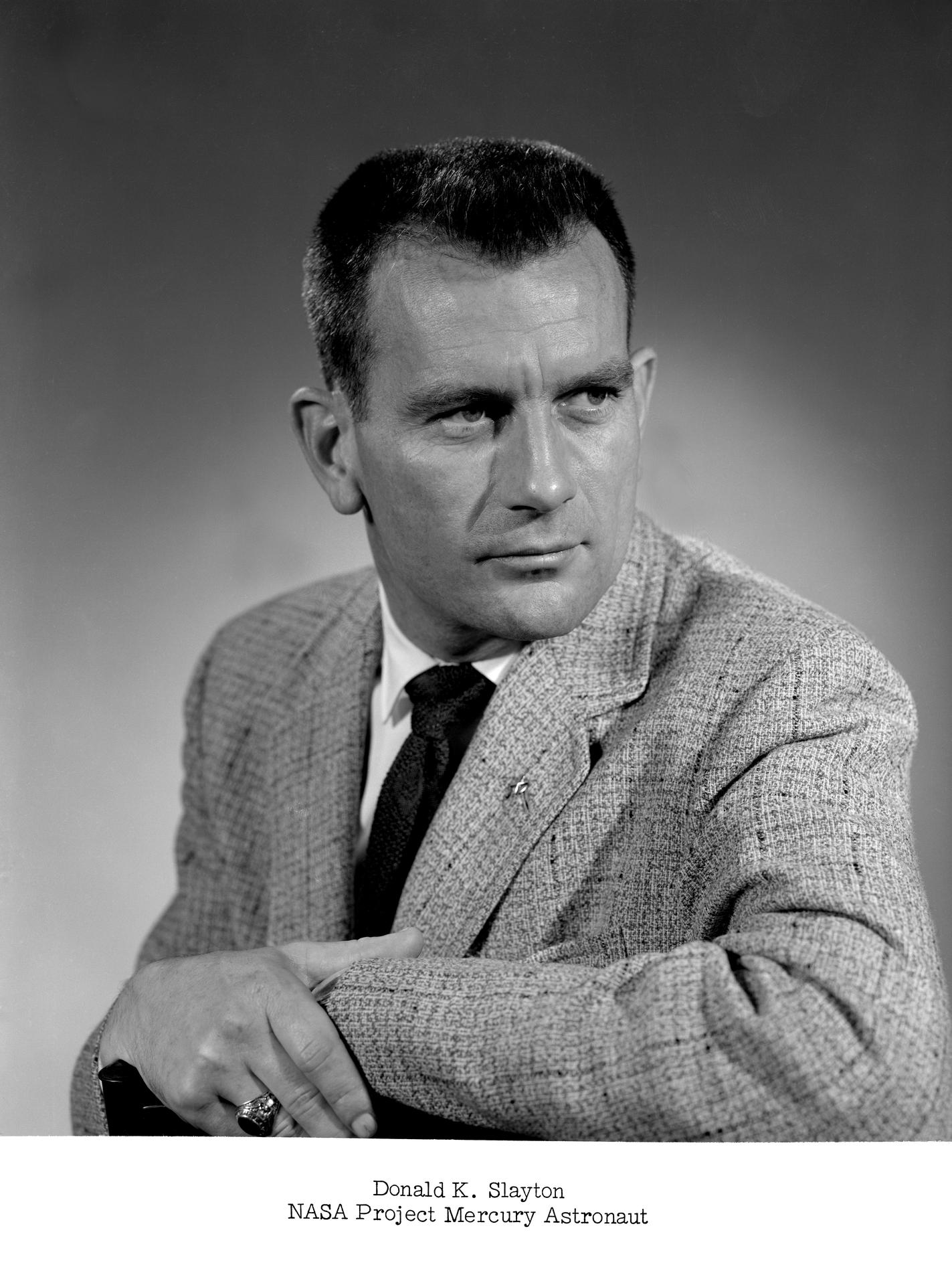
by Tara Gray
Donald K. “Deke” Slayton (Major, USAF, Ret.) was born on March 1, 1924, in Sparta, Wisconsin, to parents Charles Sherman and Victoria Adelia (Larson) Slayton.1 Slayton graduated from Sparta High School, Sparta, Wisconsin, in 1942, and then enlisted in the Army Air Corps as an aviation cadet on his 18th birthday, March 1, 1942.2 He completed flight training at Vernon and Waco, Texas, and received his wings and commission in April 1943. He was sent to Europe where he flew 56 combat missions in B-25 medium bombers with the 340th Bombardment Group. He returned to the United States in mid-1944 as a B-25 instructor pilot at Columbia, South Carolina, and later served with a unit responsible for checking pilot proficiency on the A-26 light bomber. In April 1945, he was sent to Okinawa with the 319th Bombardment Group and flew seven combat missions in A-26s in the Ryukyus Islands before Japan surrendered.3
Slayton served as a B-25 instructor pilot for a year following the end of World War II, and in 1946 he was discharged from the Air Force as a captain. He entered the University of Minnesota where he doubled up on courses and graduated in two years with a bachelor’s degree in aeronautical engineering in 1949.4 The Boeing Aircraft Company hired him as an engineer, and he worked in Seattle, Washington, for two years on electrical systems and wing designs. Then in 1951, he was recalled to active duty by the Minnesota Air National Guard. Upon reporting for duty, he was assigned as the maintenance flight test officer of an F-51 squadron in Minneapolis, then spent 18 months as a technical inspector at Headquarters 12th Air Force. He was also assigned as a fighter pilot and maintenance officer with the 36th Fighter Day Wing at the U.S. Air Force Base at Bitburg, West Germany.5 Slayton met his wife, the former Marjorie Lunney of Los Angeles, California, while he was in Germany. She was working for the Air Force there and the two were married on May 15, 1955.6
Returning to the United States in June 1955, Slayton attended the U.S. Air Force Test Pilot School at Edwards Air Force Base, California. He was a test pilot there from January 1956 until April 1959, and participated in the testing of aircraft built for the Air Force, as well as some foreign fighter planes.7 His last assignment in the Air Force was Chief of Fighter Test Section A.8 Slayton had been assigned to Edwards for four years when Project Mercury came into being and during this time the Air Force had recently started a new regulation limiting personnel to five years in any one assignment. Slayton began to realize that Mercury was his next logical step since his time at Edwards was nearing an end.9 Very shortly after he first heard about Project Mercury, the newly created National Aeronautics and Space Administration invited him, along with over 100 other top military test pilots, to Washington, D.C., to participate in some briefings to find out what Project Mercury was all about. When NASA inquired at the end of the briefings whether or not he was interested he replied that he was and would like to hear more. He qualified to stay on for further interviews and he earned a place among the group of 32 men who took the final tests. The candidates were subjected to numerous tests to determine their physical and psychological well-being as well as their stamina and endurance. Once he completed the testing, Slayton returned to Edwards to find three weeks worth of paperwork on his desk and spent most of his time flying back and forth from one air base to another, trying to catch up on his regular work. He was so busy after he returned from the NASA testing that he had very little time to think about the possibility of becoming an astronaut. Then Charles Donlan, associate director of Project Mercury, called him one morning to inform him that if he was still interested he had been selected to join the Space Task Group at Langley, Virginia, as a Mercury astronaut.10
On April 9, 1959, Slayton joined fellow Mercury astronauts, Alan B. Shepard, Jr., Virgil I. “Gus” Grissom, John H. Glenn, Jr., M. Scott Carpenter, Walter M. Schirra, Jr., and L. Gordon Cooper, Jr., for a press conference in Washington, D.C., to announce to the press and the world that the United States had officially joined the “space race.” Following the press conference, the astronauts returned to Langley to begin their intensive training. This included a “little of everything” ranging from a graduate-level course in introductory space science to simulator training and scuba-diving. Training continued until the Langley Space Task Force was transferred to the newly established Manned Spacecraft Center (MSC) in Houston, Texas.11 When each of the Mercury astronauts were assigned a different portion of the project and special assignments, to ensure pilot input, Slayton’s primary assignment was to gain thorough familiarity with the Atlas missile that was to hurl the Mercury capsule into earth orbit. He was intended to be the first American astronaut to orbit the earth, after a planned third suborbital flight by Glenn. But, following the flights of Shepard and Grissom, Glenn’s suborbital flight was canceled. He was reassigned to the first orbital Mercury flight and Slayton, on November 29, 1961, was named as the pilot of Mercury Atlas-7 (MA-7), the second orbital mission.12
On March 15, 1962, NASA announced that a heart condition called idiopathic atrial fibrillation (an erratic heart rate) that was first detected in November 1959, would prevent Slayton from making the flight. Carpenter was, at that time, named as the MA-7 replacement with Schirra as his backup pilot.13 The MA-7 mission was successfully completed on May 24, 1962.14 On July 11, 1962, Slayton assumed new operational, engineering and planning responsibilities within NASA’s Manned Space Flight Research Programs, including Projects Mercury, Gemini, and Apollo. He continued to participate in the astronaut training program and his physical condition was monitored on a continuous basis by members of the MSC medical staff.15 In September 1962, Slayton was assigned as Coordinator of Astronaut Activities with responsibility for directing the newly formed Astronaut Office. In November 1963, he resigned his commission as an Air Force major and continued and continued with NASA as a civilian astronaut. For three years Slayton served as assistant director of flight crew operations, a new office with responsibility for directing the Astronaut Office, Aircraft Operations Office and Flight Crew Support Division. Beginning in 1966, he served as director of flight crew operations. As director of flight crew operations, he played a key role in choosing the crew of every manned space mission, including the Apollo teams.16
Meanwhile, Slayton was doing everything possible to return to flight status. He followed a daily exercise program, quit smoking cigarettes and drinking coffee, reduced his intake of alcohol drastically, took massive doses of vitamins, and for a time took daily doses of quinidine, a crystalline alkaloid. In July 1970, the fibrillation ceased, and he was restored to full flight status in March 1972, following a comprehensive review of his medical status by NASA’s director of life sciences and the Federal Aviation Agency. Instead of breaking out the champagne, Slayton checked out a T-38 jet trainer at Ellington Air Force Base, Texas, and celebrated with an hour’s worth of aerobatic maneuvers, flying solo.17
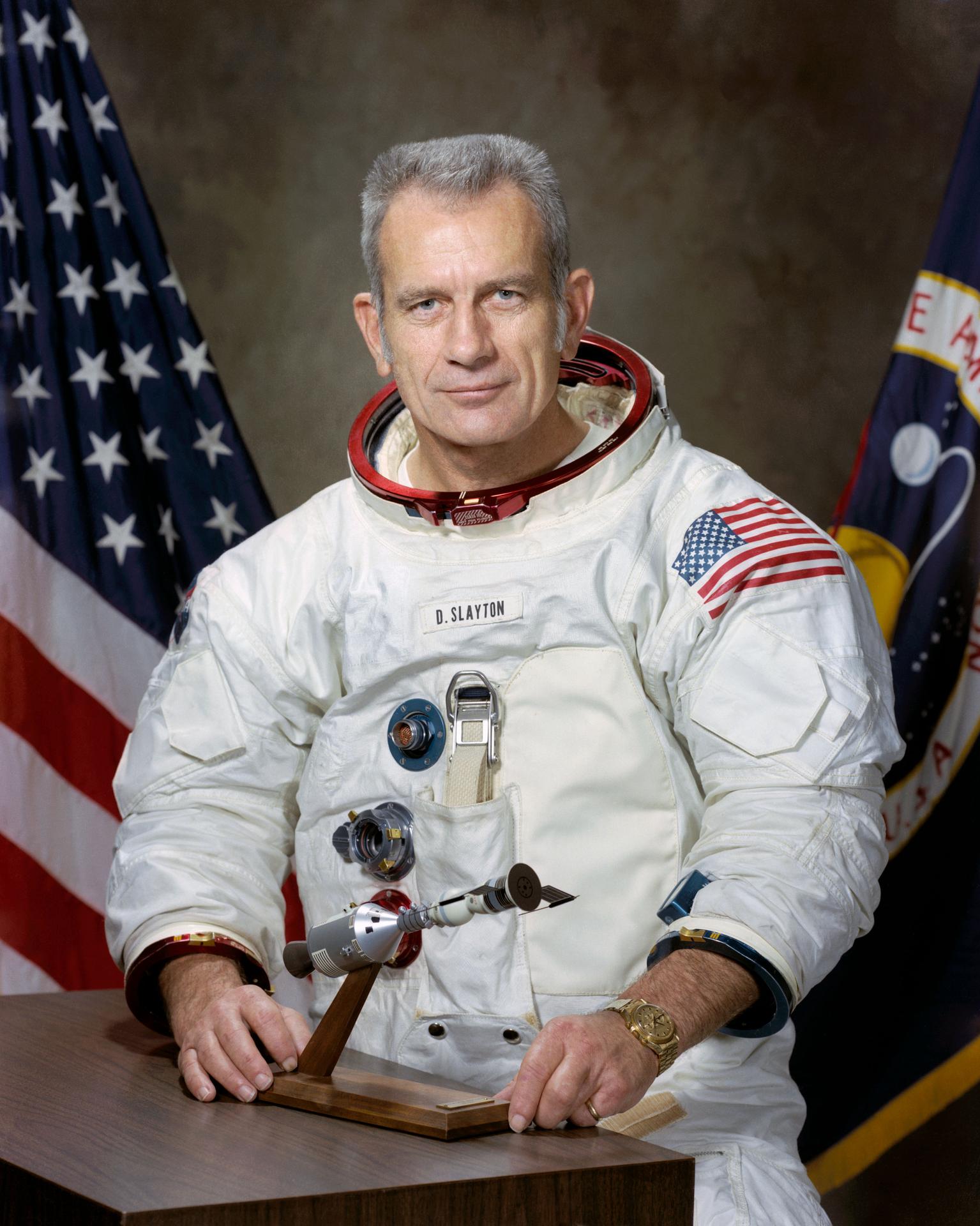
On February 9, 1973, Slayton was assigned to the Apollo-Soyuz Test Project (ASTP) along with Thomas P. Stafford and Vance D. Brand. The astronauts immediately began an intensive two-year training program that included learning the Russian language and making frequent trips to the Soviet Union, where they trained for weeks at Star City, the cosmonaut training center near Moscow. Slayton resigned as director of flight crew operations in February 1974.18
Slayton’s first and only spaceflight began on July 15, 1975, when he was launched as the first Apollo Docking Module Pilot for ASTP. The flight culminated in the first meeting in space between American astronauts and Soviet Cosmonauts, when two days later Apollo and Soyuz 19 rendezvoused and docked over Europe. During the 44 hours the two ships remained linked, Slayton, Stafford and Brand conducted crew transfers with cosmonauts Aleksey A. Leonov and Valeriy Kubasov. The crews also completed a number of joint scientific experiments and engineering investigations. The major objectives of the mission were accomplished, most notably the testing of a compatible rendezvous system and androgynous docking assemblies in orbit. Apollo returned to Earth on July 24, 1975.19
Slayton logged 217 hours, 28 minutes, and 24 seconds during his only spaceflight. From December 1975 to November 1977, he served as manager for the Approach and Landing Test series at NASA’s Dryden Flight Research Center, at Edwards. That program, using space shuttle Enterprise, verified the orbiter’s pilot-guided approach and landing capability and subsonic airworthiness in preparation for the first manned orbital flight. The program ended with five free flights between August and October 1977.20
From November 1977 to February 1982, Slayton served as manager for the Orbital Flight Training Program, directing orbital flight mission preparations and conducting mission operations during the first four shuttle spaceflights. He was also responsible for the Boeing 747/orbiter ferry program. Slayton retired from NASA on February 27, 1982, to become president and vice chairman of the board of Space Services Incorporated, a Houston-based private space firm that successfully launched it’s Conestoga rocket in 1983 and subsequently offered to send human ashes into permanent orbital repose.21
In 1983, Space Services, American Science and Technology and Aeros Data Corporation formed a joint-venture called Space America Incorporated with Slayton as the chairman. In addition to serving as a consultant to some aerospace corporations, he was president of International Formula One Pylon Air Racing and director of Columbia Astronautics. He also served on the Department of Transportation’s Commercial Space Advisory Committee.22
Slayton accumulated numerous awards and honors during his time with the Air Force and NASA, including: an honorary Doctorate of Science from Carthage College, in 1961; an honorary Doctorate of Engineering from Michigan Technological University in 1965; four NASA Distinguished Service Medals; two NASA Outstanding Leadership Medals, in 1978 and 1981; NASA Exceptional Service Medal; National Aeronautics Association (NAA) Robert J. Collier Trophy, in 1962; Society of Experimental Test Pilots (SETP) Iven C. Kincheloe Award, in 1963, and J.H. Doolittle Award, in 1972; General Billy Mitchell Award; National Institute of Social Science (NISS) Gold Medal, in 1975; Zeta Beta Tau’s Richard Gottheil Medal, in 1975; Veterans of Foreign Wars (VFW) National Space Award, in 1976; Federation Aeronautique Internationale (FAI) Yuri Gagarin Gold Medal, in 1976; American Heart Association’s Heart of the Year Award, in 1976; District 35-R Lions International American of the Year Award, in 1976; American Institute of Aeronautics and Astronautics (AIAA) Special Presidential Citation, in 1977, and Haley Astronautics Award, in 1978; University of Minnesota’s Outstanding Achievement Award, in 1977; Houston Area Federal Business Association’s Civil Servant of the Year Award, in 1977; and the American Astronautical Society (AAS) Flight Achievement Award, for 1976–1977.23
Slayton had gray hair, blue eyes, stood 5 feet 10 inches, and weighed 165 pounds. He was married to the former Marjorie Lunney until their divorce. He married the former Bobbie Osborn of Dickinson, Texas, on October 8, 1983. He had one child, Kent Sherman, born on April 8, 1957, by his first marriage.24 Slayton died of brain cancer in June 1993.25
Additional information about Slayton, including his official NASA biography.
Notes
- Hawthorne, Douglas B. Men and Women of Space (San Diego: Univelt Incorporated, 1992), p. 675.
- Carpenter, M. Scott, et al. We Seven (New York: Simon and Schuster, 1962), p. 87.
- Hawthorne, p. 676.
- Ibid., pp. 675–676.
- Ibid., p. 676.
- Carpenter, et al., p. 88.
- “Donald K. Slayton.” Manned Spacecraft Center Biographical Data (Houston, Texas: July 1968), p. 2.
- “Donald Kent Slayton.” National Aeronautics and Space Administration (Washington, DC: May 1961).
- Carpenter, et al., pp. 88–89.
- Ibid., pp. 94–95.
- “John Glenn.” John Glenn Biography, 1998. http://muskingum.edu/~publicr/history/glenn.html (July 8, 1998), p. 3.
- Hawthorne, p. 676.
- “Carpenter Replaces Slayton as MA-7 Pilot.” NASA Press Release, March 15, 1962.
- “Donald Kent Slayton, Astronaut: NASA Manned Spacecraft Center.” Together Let Us Explore the Stars: Astronaut Series-Space Craft Explorer Supplement. Hereafter referred to as Astronaut Series.
- “Mercury Astronaut Slayton Assigned to New Duties.” NASA News Release, July 11, 1962.
- Astronaut Series.
- Hawthorne, p. 676.
- Ibid.
- Ibid., p. 677.
- Ibid.
- Ibid.
- Ibid.
- Hawthorne, p. 675.
- Ibid.
- Shepard, Alan B., Jr., and Deke Slayton. Moon Shot (Atlanta: Turner Publishing, 1994), p. 11.