


















Ignition
NASA Unveils Initiatives to Achieve America’s National Space Policy
Learn More about NASA Unveils Initiatives to Achieve America’s National Space Policy
Media Resources
Going Back to the Moon
Learn More about Going Back to the Moon
Enabling Commercial Lunar Transportation to Support a Sustained Lunar Base
NASA is seeking information from established commercial providers and new industry entrants to help shape a future acquisition strategy for commercial human lunar transportation services capable of supporting a permanent, continuously crewed U.S. lunar base. This Request for Information responds directly to the December 2025 Executive Order, “Ensuring American Space Superiority,” which mandates rapid expansion of U.S. lunar capabilities, increased mission cadence, commercial partnership, and resilient cislunar infrastructure. NASA invites responses focusing on architectures that can support high‑tempo human transportation, logistics resupply, and crew rotation tempo required for lunar base operations. Proposed systems must be capable of rendezvous, proximity operations, and docking with existing human landing system (HLS) providers, while also demonstrating a credible evolution path to meet future Artemis architecture needs. Optional expanded capabilities may be proposed, provided they remain secondary to the core human‑transport mission.
The RFI seeks detailed input across technical, programmatic, and business case considerations, including transportation architecture concepts, scalable launch cadence, staging orbits, autonomous operations, interoperability with current and future Artemis elements, and approaches to human‑rating, safety, and certification. NASA also requests insight regarding manufacturing scalability, reuse strategies, demonstration plans, milestone‑based development, and projected cost structures aligned with future Firm‑Fixed‑Price service acquisition. NASA welcomes input from incumbent providers that evolve existing systems to increase cadence, reduce cost, and accelerate readiness, and transition toward commercially sustainable human space transport capabilities. Industry is asked to describe market synergies, non‑NASA customers, domestic sourcing, teaming strategies, and how proposed solutions leverage or benefit NASA Centers. Responses will inform NASA’s long‑term strategy to transition from government‑driven missions to a commercially sustained lunar transportation ecosystem that ensures U.S. leadership and operational freedom in the cislunar domain.
Building the Moon Base
Learn More about Building the Moon Base
Commercial Lunar Payloads Delivery 2.0 Follow-on Procurement
NASA is advancing its lunar exploration program with the launch of the CLPS 2.0 procurement, a competitive follow-on to the highly successful CLPS 1.0 initiative. Building on the achievements and lessons learned from its predecessor, CLPS 2.0 will continue to deliver payloads to the lunar surface and orbit, supporting NASA’s ambitious goals for sustained lunar operations. This next phase introduces enhanced flexibility, allowing NASA to order turn-key delivery services or accept delivery of CLPS hardware for integration into its own missions.
Under CLPS 2.0, NASA anticipates an increased mission cadence, coupled with greater government insight and collaboration with vendors to improve mission reliability and success. With an anticipated 10-year ordering period and a fifteen-year execution timeline, the program is targeted to be capped at $6 billion, ensuring a robust and sustained investment in lunar exploration. NASA’s CLPS 2.0 represents a critical step forward in NASA’s commitment to advancing science, technology, and infrastructure development on the Moon, paving the way for a permanent human presence in space.
Moon Base Capabilities
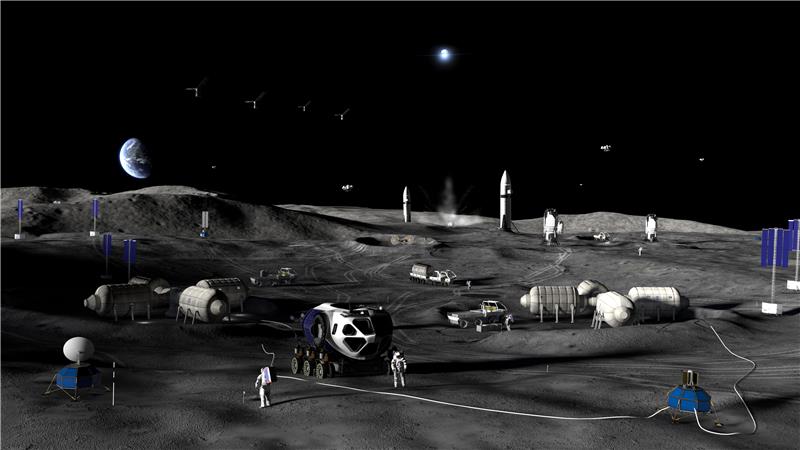
NASA is taking bold steps toward establishing a permanent lunar outpost by 2030, in alignment with the President’s Space Superiority Executive Order. The Moon Base will serve as a hub for lunar exploration, scientific research, and technology demonstration, laying the foundation for future missions to Mars and beyond. To accelerate this vision, NASA has issued a Request for Information (RFI) seeking input from industry, academia, and other stakeholders on technologies and hardware solutions that can be rapidly developed or repurposed for demonstration testing on the lunar surface within the next two to four years. These demonstrations will validate capabilities, inform future development, and expedite the timeline for initial lunar surface operations.
The RFI also invites ideas to address critical supply chain and test facility challenges that could impact the development of the Moon Base. Key areas of interest include propellant tank dome manufacturing, high-thrust hypergolic engines, radiation-hardened electronics, and hypergolic test stands capable of altitude testing, among others. NASA is committed to fostering collaboration and innovation, encouraging respondents to propose solutions that integrate seamlessly with existing systems while leveraging partnerships and resources. This initiative underscores NASA’s dedication to advancing lunar exploration and ensuring the success of its ambitious Moon Base program.
Lunar Terrain Vehicle Services Contract
NASA is advancing its lunar exploration program with a revised task ordering approach for its Lunar Terrain Vehicle Services (LTVS) contract, aimed at supporting the development of a permanent Moon Base. This initiative focuses on acquiring multiple crewed and uncrewed rovers with initial operating capabilities by 2028. Uncrewed LTVs will feature basic autonomy and teleoperations, a minimum operational life of one year, and the ability to traverse at least 800 kilometers, with added incentives for surface improvement demonstrations. Crewed LTVs will provide astronauts with essential mobility, a minimum operational life of one year, and a traverse distance of at least 900 kilometers, including 100 kilometers of additional crewed traverses.
To meet the ambitious timeline, NASA is adopting a phased task order competition approach, enabling the procurement of multiple rovers while fostering innovation and leveraging insights from lunar operations. The first phase will see competition among three current LTV contractors — Astrolab, Intuitive Machines, and Lunar Outpost — with future phases opening opportunities for additional vendors through onramp competitions. This strategy supports the President’s December 2025 Executive Order for Space Superiority, ensuring timely lunar surface mobility and advancing the effective buildout of a sustainable Moon Base.
The Lunar Terrain Vehicle Contract Draft Request for Proposal has been provided to the vendors.
Commercial Lunar Payloads Delivery CX-2 Task Order 1.0 Contract
NASA’s CLPS (Commercial Lunar Payload Services) project is igniting lunar exploration with the launch of the CX-2 Task Order, focused on delivering the Lunar Terrain Vehicle to the Moon’s South Pole. This competitive procurement, executed under the CLPS 1.0 indefinite-delivery/indefinite-quantity (IDIQ) framework, seeks to acquire delivery of one or more LTVs to support the development of NASA’s Moon Base. To ensure reliability and timely delivery, vendors are required to propose landers with proven heritage, ensuring readiness for deployment in 2028.
The CX-2 Task Order represents a strategic investment in lunar exploration and will play a critical role in enabling mobility and infrastructure development for sustained lunar operations, marking a significant step toward establishing a permanent human presence on the Moon.
The Commercial Lunar Payloads Delivery 1.0 Contract Request for Proposal has been provided to the vendors.
Commercial Lunar Payloads Delivery CS-8 Task Order 1.0 Contract
NASA’s CLPS project is launching the CS-8 Task Order, for Moon Base payload deliveries under the existing CLPS 1.0 indefinite-delivery/indefinite-quantity (IDIQ) framework. This competitive procurement aims to accelerate lunar exploration by soliciting the delivery of payloads aboard landers with proven heritage, ensuring readiness for deployment by the end of 2028. To incentivize innovation, NASA has included a performance bonus for contractors who successfully demonstrate “survive the night” capabilities by deploying a radioisotope device and transmitting signals from the lunar surface after enduring a full lunar night.
The effort represents a strategic investment in the domestic supply chain, leveraging existing capabilities to accelerate mission timelines while fostering industry growth, with multiple task order awards anticipated from this solicitation with deliveries through Fiscal Year 2029. This initiative not only strengthens the supply chain, but also expands contractor capabilities to meet the increasing demands of lunar exploration.
The Commercial Lunar Payloads Delivery 1.0 Contract Request for Proposal has been provided to the vendors.
Staying in Low Earth Orbit
Learn More about Staying in Low Earth OrbitLow Earth Orbit Destinations
Seeking feedback to guide NASA’s future acquisition strategy for a new U.S. Space Station Core Module and associated commercial modules; covers operational concepts, architecture, technical trades, supply chain, acquisition approaches, requirements, standards, commercial opportunities, and government furnished support.
Low Earth Orbit Transportation
Seeking input from commercial providers and new entrants to shape its strategy for crew and cargo transportation to future Commercial Low Earth Orbit (LEO) destinations as the International Space Station nears its end-of-life. The agency aims to ensure uninterrupted transportation services to support groundbreaking research, technology development, and commercial market growth, with anticipated demand for two crew missions and four to five cargo missions annually. NASA invites feedback on cost reduction, human-rating certification, and innovative approaches to sustain reliable and competitive transportation systems in LEO.
Golden Age of Science and Discovery
Learn More about Golden Age of Science and Discovery
Lunar Science and Technology Payloads
Seeks information about potential lunar payloads from diverse entities to support increased CLPS missions aligned with the Artemis program’s goals for lunar exploration and establishing a permanent lunar presence by 2030. The RFI aims to identify ready-to-fly and medium-term payloads for lunar surface and orbital delivery from industry, academia, non-profits, government agencies, and foreign entities except those with bilateral ties to China.
Atmospheric Microwave Radiometry Observations for NASA FALCON
Seeks low-cost concepts for a commercially operated microwave radiometer to fly in formation with the FALCON constellation, aiming for launch by Q3 Fiscal Year 2029. This initiative supports atmospheric science goals aligned with the Earth Science Decadal Survey and NASA’s Earth Science to Action Strategy 2024-2034.
Advancement of “Science as a Service” for NASA and Commercial Partners
Seeks input from various sectors to inform the development of the “Science as a Service” initiative, aimed to leverage commercial capabilities and guide government investments to accelerate technology development and transition for Earth Science, Heliophysics Space Weather, and Astrophysics programs. Goals include speeding technology maturation, enable testing and validation, and promoting rapid transition of NASA technologies for operational use and commercial markets.
America Underway in Space on Nuclear Power
Learn More about America Underway in Space on Nuclear Power