




















NASA Celebrates a Year of Progress Since First X-59 Flight
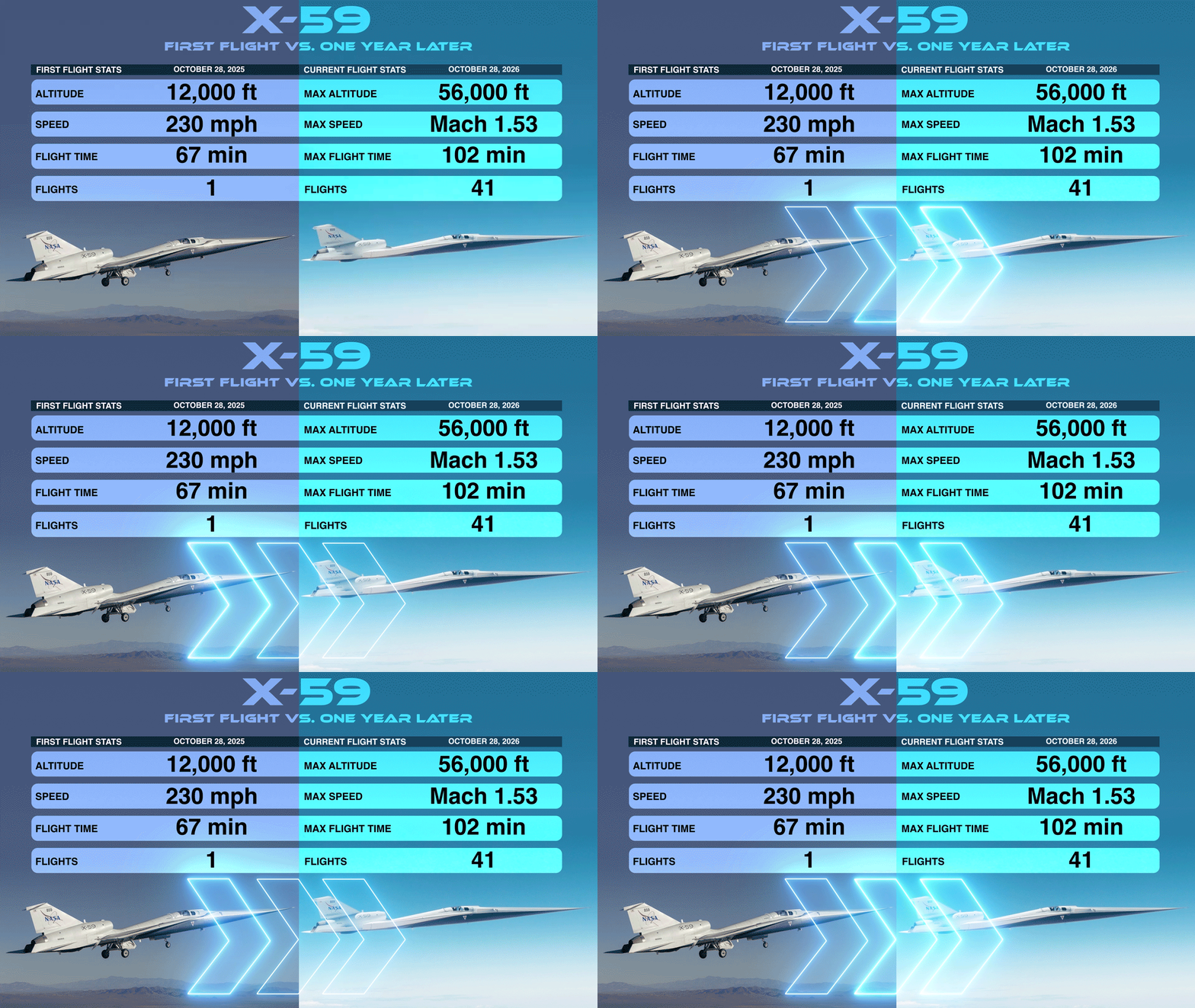
One year ago, NASA’s Quesst mission made history with the first flight of the X-59 quiet supersonic research aircraft. Since then, the X-59 has completed 40 additional flights, marking a year of steady progress for the program.
While its first flight on Oct. 28, 2025, focused on low, slow flights to conduct systems checks, the X-59 has since reached a maximum altitude of more than 56,000 feet and speeds up to Mach 1.53.
The X-59 has spent the past year expanding its flight envelope, flying at the altitudes, speeds, and conditions that will be utilized for all aspects of the Quesst mission. The aircraft’s team will continue that work in the coming months, but also transition toward a new phase of testing: acoustic validation, which will focus on analyzing the sounds the X-59 makes.
The X-59 is shaped so that when it flies at its intended quiet supersonic altitude of 55,000 feet and speed of Mach 1.4, people on the ground won’t hear a loud sonic boom – they’ll hear a thump projected to sound like a car door closing from about 20 feet away. During future flight tests, NASA will study and record those sonic thumps.
NASA’s Quesst mission aims to help enable a new era of commercial supersonic flight over land, exploring the potential for a new market of faster air travel. Learn more about the Quesst mission on NASA’s site.
Learn more about the Quesst mission on NASA’s site.
